
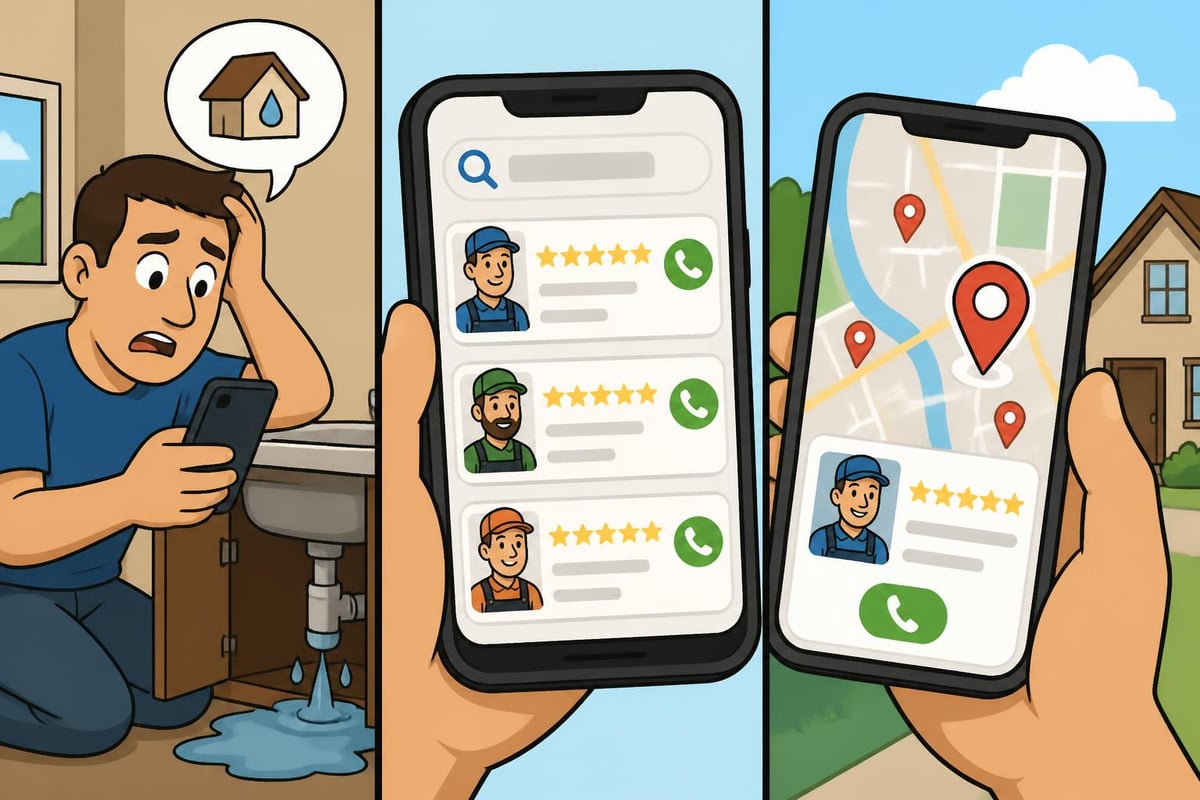
If you're a plumber, electrician, HVAC technician, or any home service contractor, you already know that most of your customers start their search online. When a homeowner's water heater breaks at 10 PM or their AC fails during a summer heatwave, they're not flipping through the Yellow Pages. They're grabbing their phone and typing "emergency plumber near me" into Google. That's why mastering seo for home service contractors isn't just a nice-to-have anymore, it's essential for sustainable business growth. The right SEO strategy puts your business front and center when potential customers need you most, turning local searches into booked appointments and loyal clients.
Why Home Service Contractors Need SEO in 2026
The home services industry has become intensely competitive online. Homeowners now research contractors before making any hiring decisions, reading reviews, comparing websites, and checking portfolios.
SEO gives you a competitive edge by ensuring your business appears prominently when potential customers search for the services you offer. Instead of relying solely on expensive pay-per-click ads or lead generation platforms that take a cut of your profits, organic search visibility delivers consistent, high-quality leads without ongoing ad spend.
Here's what effective SEO delivers for contractors:
- Higher visibility in local search results
- More qualified leads from homeowners actively seeking your services
- Better return on investment compared to traditional advertising
- Increased credibility and trust with potential customers
- Long-term sustainable growth that compounds over time
The landscape has shifted dramatically. According to industry research, over 90% of homeowners research service providers online before contacting them. If you're not showing up in those searches, you're invisible to a massive portion of your potential customer base.
Understanding Local Search for Home Services
Local SEO is the cornerstone of seo for home service contractors. Unlike national e-commerce businesses, you serve specific geographic areas. Your ideal customer isn't someone across the country; it's the homeowner within your service radius who needs help right now.
The Google Business Profile Foundation
Your Google Business Profile (formerly Google My Business) is arguably your most important digital asset. When someone searches "electrician near me" or "HVAC repair in [city name]," Google displays a local pack showing three businesses with their locations on a map.
Optimizing your Google Business Profile involves:
- Claiming and verifying your business listing
- Selecting accurate service categories (primary and secondary)
- Adding complete business information (hours, phone, service areas)
- Uploading high-quality photos of your work, team, and vehicles
- Collecting and responding to customer reviews consistently
- Publishing regular updates about services, offers, and company news
The contractors who dominate local search don't just set up their profiles once and forget about them. They actively manage these listings, respond to reviews within 24 hours, and keep information current. This ongoing engagement signals to Google that your business is active and trustworthy.
Service Area Optimization
Most contractors don't work from a single storefront. You serve multiple cities, towns, and neighborhoods within a region. Your SEO strategy for contractors needs to account for every location you serve.
Create dedicated service area pages for each major location. These aren't thin, duplicate pages with just the city name swapped out. Each page should offer genuine value with location-specific content, local landmarks, testimonials from customers in that area, and relevant service information.
Keyword Research That Drives Contractor Leads
Effective seo for home service contractors starts with understanding exactly what your customers are searching for. The keywords that drive revenue aren't always what you'd expect.
Types of High-Value Keywords
| Keyword Type | Example | Search Intent | Value |
|---|---|---|---|
| Emergency | "emergency plumber near me" | Immediate need | Very High |
| Service-Specific | "water heater installation" | Ready to hire | High |
| Problem-Based | "why is my AC leaking" | Research phase | Medium |
| Comparison | "best HVAC companies in [city]" | Evaluation | Medium-High |
Emergency and service-specific keywords typically convert best because searchers have immediate needs. Someone searching "furnace repair near me" in January is likely experiencing a problem right now and ready to hire quickly.
Don't neglect informational keywords, though. When you answer questions like "how to know if I need a new roof" or "signs of electrical problems," you build authority and capture potential customers early in their research journey. Many of these searchers will remember your helpful content when they're ready to hire.
Long-Tail Opportunities
Long-tail keywords are longer, more specific search phrases that often have less competition. Instead of targeting just "plumber," consider phrases like "licensed plumber for kitchen remodels in Doylestown" or "24-hour emergency HVAC repair Bucks County."
These searches might have lower volume, but they're incredibly targeted. The searcher knows exactly what they want, and if you match that need, conversion rates skyrocket. Building content around dozens of these long-tail variations creates a comprehensive web of search visibility across your home services niche.
On-Page SEO Essentials for Contractor Websites
Your website is your digital storefront. Every page needs optimization to rank well and convert visitors into customers.
Title Tags and Meta Descriptions
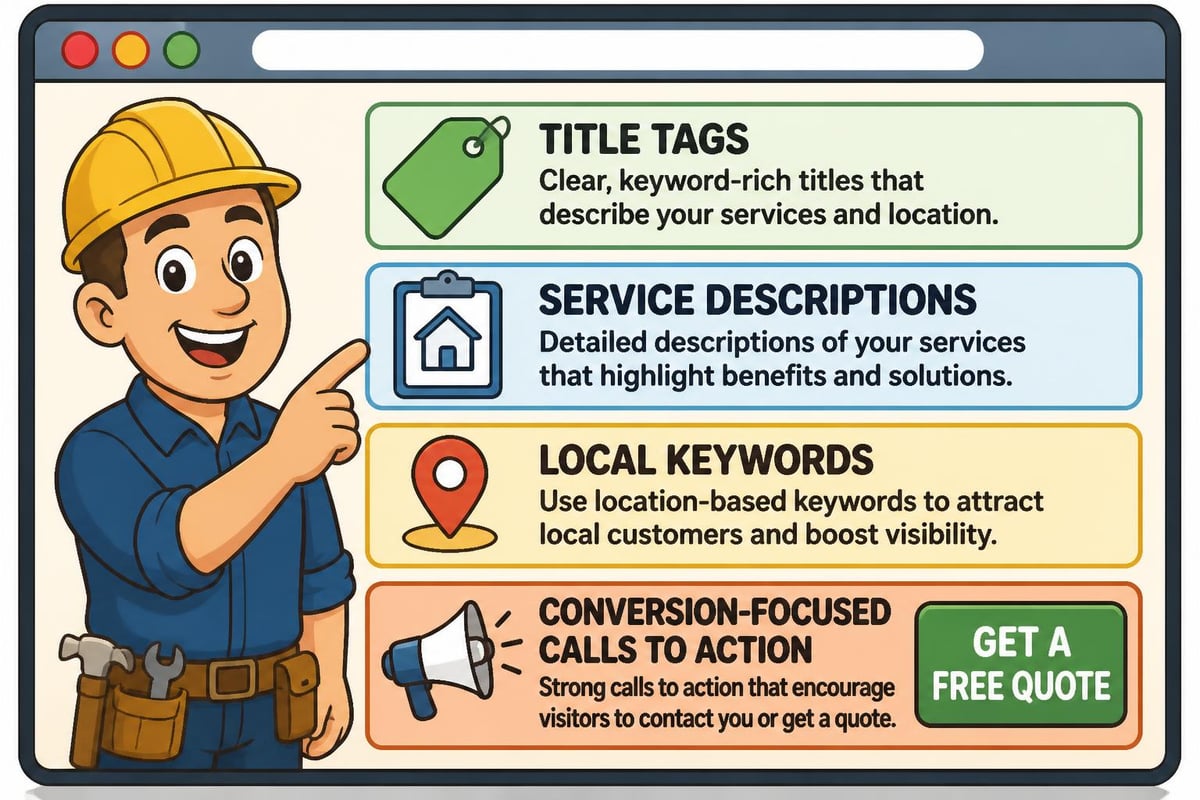
Each page needs a unique, compelling title tag that includes your target keyword and location. Keep it under 60 characters so it displays fully in search results.
Good example: "Licensed Electrician in Bucks County, PA | Same-Day Service"
Poor example: "Home | ABC Electric"
Meta descriptions don't directly impact rankings, but they influence click-through rates. Write compelling 150-character descriptions that tell searchers exactly what they'll find and why they should choose you.
Content Structure and Headers
Organize your content with clear hierarchical headers. Use H2s for main sections and H3s for subsections. This structure helps both search engines understand your content and users scan for the information they need.
Break up long paragraphs with bullet points, numbered lists, and tables. Homeowners researching contractors often skim content quickly on mobile devices. Making your information scannable improves user experience and keeps visitors engaged longer, both positive ranking signals.
Service Page Optimization
Each service you offer deserves its own dedicated page. Don't lump everything into a generic "Services" page. Create separate pages for:
- Specific services (furnace repair, air conditioner installation, ductwork replacement)
- Emergency services
- Commercial vs. residential offerings
- Seasonal services
Each page should include detailed information about the service, benefits, your process, pricing guidance (even ranges help), and a clear call-to-action. Include relevant images showing your team performing that specific work.
Building Authority Through Content Marketing
Content marketing sets successful contractors apart from competitors who only have basic service pages. When you publish helpful, educational content regularly, you demonstrate expertise and build trust with potential customers.
Blog Topics That Attract Homeowners
Start a blog focused on answering the questions your customers actually ask. Every service call, estimate, and customer conversation reveals content opportunities.
High-value blog topics include:
- Seasonal maintenance guides ("Preparing Your HVAC System for Winter")
- Troubleshooting common problems ("5 Reasons Your Circuit Breaker Keeps Tripping")
- Cost guides ("What Does a New Roof Cost in 2026?")
- DIY vs. professional advice ("When to Call a Plumber vs. Fixing It Yourself")
- Local building codes and regulations
- Product comparisons and recommendations
These articles target informational keywords that bring traffic early in the customer journey. Include clear calls-to-action within the content directing readers to contact you when professional help is needed.
Video Content for Contractors
Video content has exploded in importance for local SEO. Create short videos showing:
- Before and after project transformations
- Explanations of common problems
- Customer testimonials
- Your team and company culture
- How-to guides for simple maintenance
Upload videos to YouTube with location-specific titles and descriptions, then embed them on relevant website pages. This dual approach captures YouTube searches and enhances your website's engagement metrics. Many contractors have found that comprehensive SEO strategies for home services include video as a core component.
Technical SEO Fundamentals
Technical SEO ensures search engines can properly crawl, index, and understand your website. Even the best content won't rank if technical issues hold you back.
Mobile Optimization Is Non-Negotiable
Over 60% of home service searches happen on mobile devices. Someone with a plumbing emergency isn't waiting to get home to their computer. Your website must load quickly and function perfectly on smartphones and tablets.
Test your site on multiple devices. Buttons should be large enough to tap easily. Phone numbers should be clickable to dial. Forms should be simple to complete on small screens. Google's mobile-first indexing means the search engine primarily uses the mobile version of your site for ranking, making mobile optimization critical for seo for home service contractors.
Site Speed Matters
Slow websites frustrate users and hurt rankings. Compress images, minimize code, leverage browser caching, and use a quality hosting provider. Aim for page load times under three seconds.
Tools like Google PageSpeed Insights identify specific issues slowing your site down. Many contractors have outdated websites with massive, uncompressed images from job sites. Optimizing these images alone can dramatically improve load times.
Schema Markup for Contractors
Schema markup is structured data that helps search engines understand your content better. For contractors, LocalBusiness schema tells Google exactly what services you offer, where you're located, your hours, and contact information.
Adding schema for reviews displays star ratings in search results, increasing click-through rates significantly. While implementing schema requires some technical knowledge, the visibility boost makes it worthwhile.
Link Building Strategies That Work for Contractors
Backlinks from other reputable websites signal authority to Google. Quality link building remains one of the strongest ranking factors, but the tactics that work for contractors differ from other industries.
Local Citations and Directory Listings
Start with consistent citations across major directories like Yelp, Angi, HomeAdvisor, Thumbtack, and industry-specific platforms. Ensure your business name, address, and phone number (NAP) are identical across all listings. Inconsistent information confuses search engines and dilutes your local SEO efforts.
Beyond the major directories, look for local business associations, chamber of commerce listings, and community websites. A link from your local chamber's member directory carries more weight for local searches than a random national directory.
Strategic Partnership Opportunities
Build relationships with complementary local businesses. Interior designers, real estate agents, property managers, and general contractors often need reliable subcontractors to recommend.
These partnerships can lead to natural link opportunities:
- Guest posts on real estate blogs about preparing homes for sale
- Resource pages on property management sites
- Partnerships with home warranty companies
- Sponsorships of local events with website mentions
Focus on genuine relationships that provide mutual value rather than purely transactional link exchanges.
Earning Links Through Exceptional Work
Your best link building strategy is doing remarkable work that people naturally want to share. Exceptional before-and-after projects, unique solutions to challenging problems, or community involvement all generate organic attention.
Document your most impressive projects thoroughly. When you complete a complex historical home restoration or innovative green building project, reach out to local news outlets, architectural blogs, or industry publications. These earned media mentions often include valuable backlinks to your website.
Understanding the broader landscape of home services SEO helps you identify link opportunities your competitors miss.
Review Management and Reputation
Online reviews have become the digital equivalent of word-of-mouth referrals. They influence both search rankings and customer decisions.
The SEO Value of Reviews
Google considers review quantity, quality, recency, and diversity when ranking businesses. A steady stream of fresh reviews signals an active, reliable business. Review content also provides natural keyword variations as customers describe your services in their own words.
Review optimization involves:
- Asking satisfied customers for reviews at the right time
- Making the process easy with direct links
- Responding to every review, positive and negative
- Addressing concerns professionally and promptly
- Showcasing reviews on your website
Never buy fake reviews or incentivize positive reviews with discounts. These tactics violate platform policies and damage credibility when discovered. Authentic reviews from real customers carry far more weight.
Responding to Negative Reviews
How you handle negative reviews demonstrates professionalism and can actually enhance your reputation. Respond quickly, acknowledge concerns, apologize when appropriate, and offer to resolve issues offline.
Future customers reading your responses see a business that cares about customer satisfaction and takes accountability seriously. A business with all five-star reviews often seems suspicious, while a few lower ratings with professional responses builds authenticity.
Measuring SEO Success for Home Service Businesses
Tracking the right metrics helps you understand what's working and where to focus improvement efforts.
Key Performance Indicators
| Metric | What It Measures | Why It Matters |
|---|---|---|
| Organic Traffic | Website visitors from search | Overall visibility growth |
| Local Pack Rankings | Position in map results | High-intent local searches |
| Keyword Rankings | Positions for target terms | Competitive performance |
| Conversion Rate | Visitors who contact you | Lead quality and site effectiveness |
| Cost Per Lead | Marketing investment per inquiry | ROI comparison |
Don't obsess over rankings alone. A first-page position for "plumber" means nothing if it doesn't generate phone calls. Focus on keywords that drive qualified leads and measure actual business outcomes.
Tools for Tracking Progress
Google Analytics shows website traffic sources, user behavior, and conversion tracking. Set up goals for form submissions, phone clicks, and other lead actions to measure how organic traffic converts.
Google Search Console reveals which searches display your site, your average position, and click-through rates. This free tool identifies opportunities to improve existing rankings and discover new keywords you're already ranking for.
Local rank tracking tools show your position in map results across different locations within your service area. These specialized tools account for location-based search variations that standard rank trackers miss.
Getting a clear picture of your current standing in both traditional search and emerging AI platforms can jumpstart your visibility strategy. Many contractors benefit from starting with an assessment that maps out exactly where they appear now and the specific steps needed to dominate their market. This focused approach creates a roadmap for systematic improvement across all the channels where customers discover service providers today.

Creating a Sustainable SEO Strategy
Success with seo for home service contractors requires consistent effort over time, not quick fixes or one-time optimizations. Building a sustainable approach ensures long-term growth.
Monthly SEO Activities
Dedicate time each month to core SEO activities:
- Publishing new blog content (2-4 articles minimum)
- Updating service pages with fresh information
- Monitoring and responding to reviews
- Checking Google Business Profile for questions and updates
- Analyzing performance metrics and adjusting strategy
- Building new citations and links
- Optimizing existing content based on performance data
Even 10-15 hours monthly makes a significant difference. Consistency beats intensity. Regular, modest efforts compound over months and years into substantial visibility gains.
Seasonal SEO Considerations
Home service needs fluctuate seasonally. HVAC contractors see different search patterns in summer versus winter. Roofers get storm-related searches after severe weather. Landscapers experience dramatic seasonal swings.
Anticipate these patterns and prepare content in advance. Publish furnace maintenance articles in early fall before heating season. Create storm damage content before hurricane or tornado season peaks in your region. This proactive approach captures traffic when search volume spikes.
Competitive Analysis
Regularly review what competitors are doing online. Which keywords are they ranking for that you're missing? What content topics are they covering? What does their Google Business Profile look like compared to yours?
Tools like SEMrush and Ahrefs reveal competitor keywords and backlinks. Don't copy competitors, but use this intelligence to identify gaps in your strategy and opportunities they're overlooking.
The most comprehensive approaches to contractor SEO combine technical excellence with consistent content creation and ongoing optimization.
Common SEO Mistakes Contractors Make
Avoiding common pitfalls saves time and accelerates results. Many contractors unknowingly sabotage their SEO efforts with preventable mistakes.
Neglecting Website Fundamentals
Some contractors invest heavily in advertising while their website remains outdated, slow, or difficult to navigate. Your website is the foundation everything else builds upon. No amount of traffic helps if your site doesn't convert visitors into leads.
Critical website elements include:
- Fast load times on all devices
- Clear, prominent phone numbers and contact forms
- Trust signals like licenses, insurance, certifications
- Professional photos of your team and completed work
- Easy navigation that guides visitors to take action
Before investing significantly in traffic generation, ensure your website effectively converts the traffic you already have.
Keyword Stuffing and Over-Optimization
Some contractors still believe cramming keywords into every sentence helps rankings. This outdated tactic now triggers spam filters and hurts readability. Write naturally for human readers first, incorporating keywords where they fit contextually.
Google's algorithms have become sophisticated enough to understand context, synonyms, and related concepts. You don't need to repeat "emergency plumber in Philadelphia" fifteen times on a page. Natural variations and related terms work better.
Ignoring Mobile Users
With the majority of searches happening on mobile devices, a desktop-only mindset is business suicide. Test your website on actual phones and tablets regularly. What looks great on a 27-inch monitor might be unusable on a smartphone.
Pay special attention to forms. Long, complex forms with tiny input fields frustrate mobile users. Simplify contact forms to essential fields only. Every additional field decreases completion rates.
Inconsistent NAP Information
Your business name, address, and phone number must match exactly across your website, Google Business Profile, and all directory listings. Even small variations like "Street" versus "St." or including a suite number in some places but not others creates confusion.
Audit all your online listings quarterly. When you change phone numbers or locations, update every listing promptly. Inconsistent information weakens local SEO signals and frustrates customers who get outdated details.

Working With an SEO Agency vs. DIY
Many contractors wonder whether to handle SEO themselves or hire professionals. Both approaches can work, depending on your situation.
When DIY Makes Sense
Contractors with limited budgets, time to learn, and patience for gradual results can handle basic SEO themselves. Start with fundamental activities:
- Optimizing and maintaining your Google Business Profile
- Creating quality content about your services and expertise
- Building citations in major directories
- Asking customers for reviews
- Ensuring website basics are solid
Free resources and tools provide enough guidance to make meaningful progress. The challenge is consistency. Many contractors start strong but get too busy with actual service work to maintain SEO efforts.
The Agency Advantage
Professional SEO agencies bring expertise, consistency, and proven systems. An experienced agency specializing in contractor SEO understands industry-specific challenges and opportunities.
Benefits of professional help include:
- Faster results from established processes
- Technical expertise for complex optimizations
- Consistent execution regardless of your workload
- Access to premium tools and resources
- Objective outside perspective on your market
- Accountability and regular reporting
Agencies aren't cheap, but the ROI often justifies the investment when they generate consistent qualified leads. A contractor generating three additional jobs monthly from improved search visibility easily covers a professional SEO investment.
Hybrid Approaches
Some contractors handle basic tasks internally while outsourcing technical or specialized work. You might manage content creation and review responses while an agency handles link building, technical SEO, and local optimization.
This hybrid model works well for contractors comfortable with some digital marketing but lacking time or expertise for comprehensive execution. Start by getting help with an SEO audit to identify priorities, then decide which activities to handle internally versus outsource.
The Evolution of Search and AI
The search landscape continues evolving rapidly. Staying ahead of changes ensures your SEO efforts remain effective into the future.
Voice Search Optimization
Smart speakers and voice assistants have changed how people search. Voice queries tend to be longer and more conversational than typed searches. Someone might type "plumber near me" but ask Alexa "Who's the best plumber in Doylestown for emergency repairs?"
Optimize for voice search by:
- Creating content that answers specific questions
- Using natural, conversational language
- Targeting long-tail, question-based keywords
- Ensuring your Google Business Profile is complete and accurate
- Implementing structured data markup
Featured snippets and local pack results often serve as voice search answers, making these positions even more valuable.
AI and ChatGPT Search Visibility
Generative AI platforms like ChatGPT are increasingly answering user questions directly. Forward-thinking contractors are preparing for this shift by ensuring their content appears in AI responses when users ask about home service needs.
This emerging channel requires building authority through comprehensive, accurate, helpful content that AI models can reference. The fundamentals remain the same: create exceptional resources that genuinely help your audience, and emerging platforms will recognize and surface that value.
Understanding how to get found in ChatGPT and similar AI tools is becoming as important as traditional Google optimization for contractors looking to stay ahead.
Industry-Specific SEO Strategies
Different home service trades face unique SEO challenges and opportunities. Tailoring your approach to your specific business type enhances results.
HVAC Contractors
HVAC businesses benefit from seasonal content strategies. Create comprehensive guides about both heating and cooling, preparing in advance for seasonal demand spikes. Emergency service keywords convert extremely well during temperature extremes.
Consider targeting commercial HVAC keywords if you serve businesses. Commercial clients often have higher lifetime values and more predictable seasonal maintenance needs. The competition for commercial keywords is often lower than residential terms, creating easier ranking opportunities.
Strategies for HVAC contractor SEO should emphasize emergency services, maintenance programs, and equipment replacement when systems age out.
Plumbing Businesses
Plumbers can dominate local search by targeting specific problem-based keywords. Homeowners search for solutions to immediate issues: "toilet won't stop running," "water heater making noise," "slow drain solutions."
Create detailed troubleshooting content that helps with minor issues while making clear when professional help is necessary. This approach builds trust and captures potential customers early in their decision process.
Electrical Contractors
Electrical work involves safety concerns that create natural content opportunities. Emphasize licensed, insured, code-compliant work in all your content. Safety-focused content builds trust and differentiates you from unlicensed competitors.
Target both residential and commercial keywords. Many electrical contractors find less competition and higher values in commercial work. Service-specific pages for panel upgrades, EV charger installation, and smart home wiring capture growing market segments.
Roofing Companies
Roofing SEO should emphasize storm damage, insurance work, and material types. Create comprehensive guides comparing roofing materials with pros, cons, costs, and longevity. These comparison pages rank well and attract homeowners in the research phase.
Local link building works especially well for roofers through partnerships with real estate agents, home inspectors, and property management companies who regularly need reliable roofing referrals.
Different trades require customized approaches, but the fundamentals of seo for home service contractors remain consistent across all specialties.
Mastering SEO transforms how home service contractors attract and convert customers, creating sustainable growth that doesn't rely on expensive ads or lead generation platforms. By focusing on local optimization, creating valuable content, building authority, and maintaining consistency, contractors position themselves as the obvious choice when homeowners need services.
If you're ready to dominate local search results and generate a steady flow of qualified leads, Shawn the SEO Geek brings over two decades of expertise specifically helping contractors and home service businesses grow online. With hands-on, customized strategies and transparent communication, we focus on delivering the rankings, traffic, and conversions that actually grow your business. Let's build your roadmap to search visibility today.