

The legal industry has become incredibly competitive online, and potential clients now search for attorneys the same way they search for restaurants or home services. If your law firm isn't showing up when people search for legal help in your area, you're missing out on clients who are ready to hire. Attorney search engine optimization isn't just about getting traffic to your website; it's about attracting the right people who need your specific legal services and converting them into paying clients. Understanding how to optimize your online presence can mean the difference between a thriving practice and struggling to fill your calendar.
Why Attorney Search Engine Optimization Matters More Than Ever
The landscape of legal marketing has shifted dramatically over the past few years. Traditional advertising methods like billboards and Yellow Pages ads have given way to digital strategies that meet potential clients where they already are: online.
Over 96% of people seeking legal advice use a search engine as their primary research tool. That statistic alone should convince any law firm that attorney search engine optimization needs to be a core part of their marketing strategy.
Here's what makes SEO so valuable for attorneys:
- Higher intent leads: People searching for "personal injury lawyer near me" are actively looking for help right now
- Cost-effective compared to paid ads: Organic rankings don't require paying for each click
- Long-term results: Good SEO compounds over time, unlike ads that stop when you stop paying
- Builds credibility: Ranking highly signals authority and trustworthiness to potential clients
- 24/7 client acquisition: Your website works to attract clients even when you're not in the office
The challenge is that effective SEO strategies for law firms require ongoing effort and expertise. This isn't a "set it and forget it" marketing channel.

Understanding the Fundamentals of Attorney SEO
Attorney search engine optimization combines several different tactics that work together to improve your visibility in search results. Let's break down the core components you need to understand.
Keyword Research for Law Firms
Everything starts with knowing what your potential clients are searching for. Keyword research involves identifying the exact phrases people type into Google when they need legal help.
For attorneys, keywords typically fall into these categories:
| Keyword Type | Example | Search Intent |
|---|---|---|
| Practice area + location | "divorce lawyer Philadelphia" | Ready to hire |
| Legal question | "how to file for bankruptcy" | Research phase |
| Specific service | "free consultation personal injury" | Comparison shopping |
| Emergency needs | "DUI lawyer open now" | Urgent help needed |
The most valuable keywords combine your practice area with location indicators and have clear commercial intent. Someone searching for "best estate planning attorney Bucks County" is much further along in their decision-making process than someone searching for "what is a will."
On-Page Optimization Essentials
Once you know what keywords to target, you need to optimize your website pages to rank for those terms. This involves strategic placement of keywords and creating comprehensive, helpful content.
Your title tags should include your target keyword and location. Meta descriptions need to compel clicks while naturally incorporating keywords. Header tags (H2, H3) should organize your content logically and include relevant terms.
Content quality matters more than keyword stuffing. Google's algorithms have become sophisticated enough to understand context and user intent. Write for humans first, search engines second.
Each practice area should have its own dedicated page with at least 1,000-1,500 words of original, valuable content. Answer the questions your potential clients are asking. Address their concerns. Demonstrate your expertise through detailed explanations, not just marketing fluff.
Local SEO Strategies That Drive Consultations
For most attorneys, the majority of clients come from the local area. That's why local attorney search engine optimization deserves special attention and focused effort.
Optimizing Your Google Business Profile
Your Google Business Profile (formerly Google My Business) is often the first thing potential clients see when they search for legal services. Seven local SEO strategies can keep your firm competitive in local search results.
Complete every section of your profile:
- Accurate name, address, and phone number (NAP)
- All relevant practice area categories
- Regular business hours and holiday hours
- High-quality photos of your office, team, and even yourself
- Detailed business description with keywords worked in naturally
Post weekly updates to your Google Business Profile. Share legal tips, announce case results (when appropriate), or highlight community involvement. These posts show Google that your business is active and engaged.
Reviews are crucial for local rankings. Encourage satisfied clients to leave honest reviews and respond professionally to all feedback, both positive and negative.
Building Local Citations and Directory Listings
Citations are mentions of your law firm's name, address, and phone number across the web. Consistency across all platforms signals credibility to search engines.
Key directories for attorneys include:
- Avvo
- Justia
- FindLaw
- Lawyers.com
- State and local bar associations
- Chamber of Commerce listings
Make sure your NAP information is identical across every single listing. Even small variations like "Street" versus "St." can confuse search engines and dilute your local SEO power. For comprehensive visibility strategies, our SEO services for service-based businesses include thorough citation management.

Content Marketing That Establishes Authority
Creating valuable content serves dual purposes: it helps you rank for more keywords while simultaneously demonstrating your expertise to potential clients. Best practices for attorneys emphasize understanding your audience's needs and creating content that addresses those needs comprehensively.
Creating Practice Area Content That Ranks
Each area of law you practice should have multiple pieces of content supporting it. Don't just create a single "Personal Injury" page and call it done.
Instead, build out comprehensive coverage:
- Main practice area page with overview
- Specific case type pages (car accidents, slip and fall, medical malpractice)
- Process explanations ("What to expect during a personal injury case")
- FAQ pages answering common questions
- Blog posts on trending topics in that practice area
This content cluster approach signals to Google that you're an authority on the subject. Internal linking between related pages strengthens the topical relevance.
Blog Strategy for Law Firms
Regular blogging helps attorney search engine optimization in multiple ways. Each post is another indexed page, another opportunity to rank, and another chance to demonstrate expertise.
Focus on evergreen topics that remain relevant year after year. "How to choose a divorce lawyer" will be valuable in 2026 just as it was in previous years. Supplement with timely content about new laws or recent court decisions affecting your practice areas.
Make your blog posts genuinely helpful. Answer real questions. Provide actionable advice. While you can't give specific legal advice online, you can educate readers about their options and what to consider.
| Blog Post Type | SEO Benefit | Client Value |
|---|---|---|
| How-to guides | Long-tail keywords | Demonstrates expertise |
| Legal explainers | Featured snippets | Builds trust |
| Case studies | Local + practice terms | Social proof |
| FAQ compilations | Question keywords | Addresses concerns |
Technical SEO Foundations for Law Firm Websites
The behind-the-scenes technical aspects of your website significantly impact your attorney search engine optimization results. Even great content won't rank well if your site has technical problems.
Site Speed and Mobile Optimization
Google uses mobile-first indexing, meaning it primarily looks at the mobile version of your website when determining rankings. If your site isn't mobile-friendly, you're fighting an uphill battle.
Your website should load in under three seconds. Every additional second of load time increases bounce rate and hurts your rankings. Compress images, minimize code, and use a quality hosting provider.
Test your site on actual mobile devices, not just responsive design emulators. Does the phone number click to call? Are forms easy to fill out on a small screen? Can visitors navigate easily with their thumbs?
Secure and Accessible Architecture
Security is non-negotiable for attorney websites. You handle sensitive client information, and your website needs HTTPS encryption. Google gives ranking preference to secure sites.
Site structure should be logical and shallow. Visitors should be able to reach any page within three clicks from the homepage. Use clear navigation menus and breadcrumb trails.
A professional SEO website audit can identify technical issues holding back your rankings. Common problems include broken links, duplicate content, missing alt tags on images, and poor URL structure.
Link Building for Legal Websites
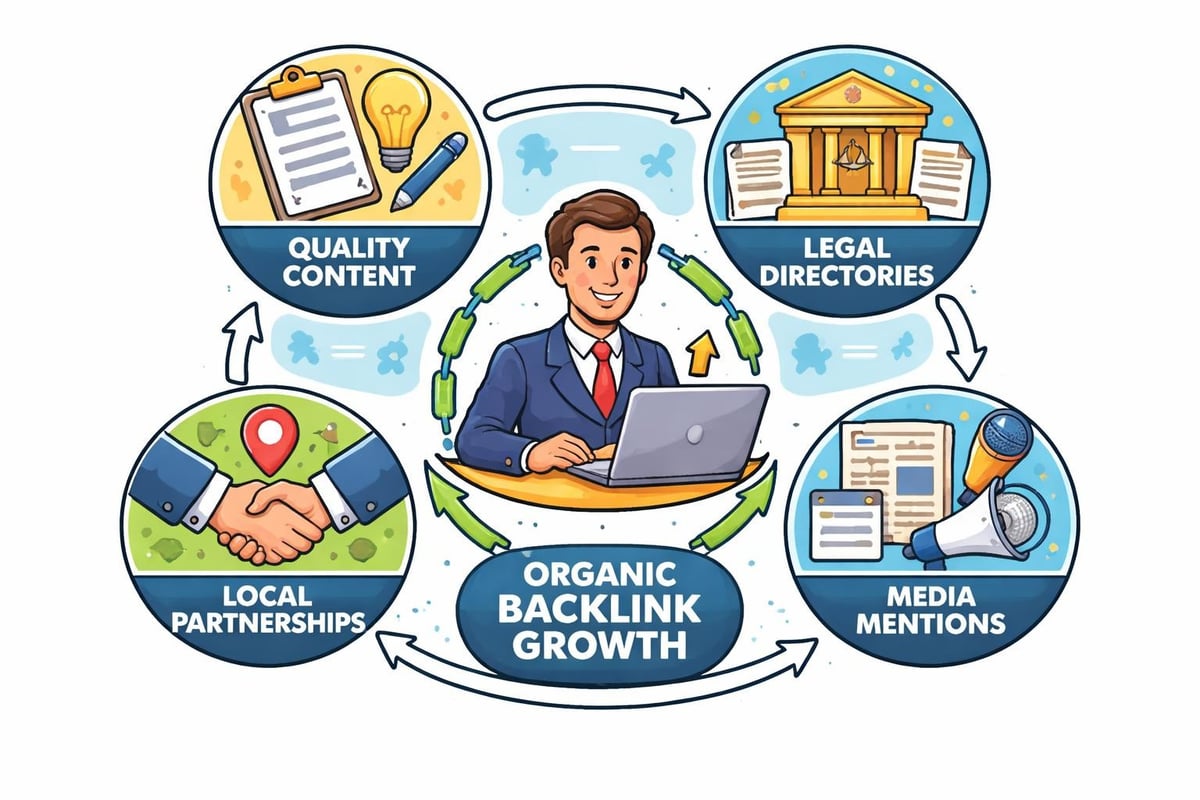
Backlinks from other reputable websites to yours remain one of the strongest ranking factors. Quality links tell Google that other sites trust and value your content.
Earning High-Quality Legal Backlinks
The best approach to link building for attorney search engine optimization focuses on earning links naturally through great content and relationships, not buying them or using spammy tactics.
Effective strategies include:
- Guest posting on legal publications: Write articles for law journals, legal blogs, or industry publications
- Local news and media: Offer expert commentary on legal issues affecting your community
- Sponsorships and partnerships: Support local organizations and events (which often include website links)
- Educational institutions: Speak at law schools or continuing education seminars
- Original research: Publish surveys or studies that other sites want to reference
One powerful link from a respected legal website is worth more than dozens of low-quality directory links. Focus on relevance and authority.
Avoiding Link Building Penalties
Google penalizes websites that use manipulative link schemes. Avoid purchasing links, participating in link exchanges, or using automated link building tools.
Natural link profiles grow gradually and include a mix of different types of links. If you suddenly gain 100 backlinks overnight, Google's algorithms will flag that as suspicious.
Measuring and Improving Your SEO Results
Attorney search engine optimization requires ongoing measurement and refinement. You can't improve what you don't measure, so tracking the right metrics is essential.
Key Performance Indicators for Law Firms
Focus on metrics that directly tie to business outcomes, not just vanity metrics like total traffic:
- Organic traffic from target keywords: Are you ranking for terms that matter?
- Consultation requests from organic search: Track form submissions and calls
- Ranking positions for priority keywords: Monitor movement in search results
- Local pack visibility: Are you in the top three local results?
- Conversion rate from organic visitors: What percentage take action?
Set up Google Analytics and Google Search Console properly. Use call tracking numbers on your website to attribute phone leads to organic search. Create separate landing pages for different practice areas to track which generate the most consultations.
Continuous Optimization Process
SEO is never "done." Comprehensive law firm SEO strategies in 2026 require ongoing attention and adjustment based on performance data.
Review your analytics monthly at minimum. Which pages are performing well? Which keywords are driving traffic but not conversions? Where are visitors dropping off?
Use this data to refine your approach:
- Update and expand existing content that's ranking on page two
- Create new content targeting keywords with high intent but low competition
- Improve pages with high traffic but low conversion rates
- Fix technical issues as they arise
- Monitor competitor strategies and adapt accordingly
The legal market is competitive, and your competitors are working on their SEO too. Staying ahead requires commitment to continuous improvement. A clear roadmap can accelerate your progress significantly. The Authority + AI Visibility Blueprint provides law firms with a comprehensive audit of their current search presence and a strategic plan for improving visibility in both traditional Google search and emerging AI platforms like ChatGPT, helping you capture leads from every search channel.

Common Attorney SEO Mistakes to Avoid
Even well-intentioned law firms make SEO mistakes that hurt their results. Awareness of these pitfalls helps you avoid wasting time and money.
Duplicate Content Across Practice Areas
Many law firms use template content across multiple practice area pages, just swapping out the practice area name. Google recognizes this and may not rank any of those pages well.
Each practice area deserves unique, specific content that addresses the particular concerns and questions related to that area of law. A DUI defense page should look nothing like an estate planning page in terms of content.
Ignoring User Experience Signals
Google increasingly factors user experience into rankings. If visitors immediately bounce back to search results, that signals your page didn't meet their needs.
Common UX issues that hurt attorney websites:
- Aggressive popups that cover content immediately
- Difficult-to-read fonts or low contrast
- Forms that require too much information upfront
- Lack of clear calls-to-action
- Slow-loading pages on mobile devices
Make it easy for potential clients to contact you. Put your phone number prominently in the header. Include multiple contact options. Make forms short and simple.
Neglecting Online Reviews and Reputation
Reviews influence both rankings and conversion rates. A law firm with 50 five-star reviews will outperform one with three reviews, even if the technical SEO is identical.
Actively request reviews from satisfied clients. Make the process easy by sending direct links. Respond to all reviews to show you're engaged and care about client feedback. For law firms specifically, best SEO practices include robust review management strategies.
The Role of Emerging Technologies in Attorney SEO
The search landscape continues evolving with AI and voice search changing how people find attorneys. Staying ahead of these trends positions your firm for long-term success.
Optimizing for Voice Search
Voice searches tend to be longer and more conversational than typed searches. Someone might type "divorce lawyer Philadelphia" but say "Hey Google, who's the best divorce lawyer near me?"
Optimize for voice by:
- Creating FAQ pages with natural language questions
- Using conversational phrases in your content
- Claiming and optimizing your Google Business Profile
- Ensuring your website loads quickly
- Focusing on local SEO signals
Voice searches often have strong local intent, making them particularly valuable for attorneys serving specific geographic areas.
AI Search and Answer Engines
Platforms like ChatGPT and other AI tools are beginning to influence how people search for information, including legal help. While traditional Google search remains dominant, preparing for AI-driven search can give you an edge.
Create comprehensive, authoritative content that AI systems can reference. Understanding SEO for AI helps position your content to be surfaced in AI-generated answers. Structure your content with clear hierarchies and factual information that AI can easily parse and understand.
Building a Sustainable SEO Strategy
Attorney search engine optimization works best as a long-term strategy, not a quick fix. The most successful law firms commit to consistent effort over months and years.
Setting Realistic Expectations
SEO typically takes 3-6 months to show meaningful results, and competitive legal markets may take even longer. You're competing against established firms that have been investing in SEO for years.
Don't expect to rank #1 for "personal injury lawyer" in a major city within a few weeks. Start with less competitive, more specific long-tail keywords and build from there. "Workers compensation attorney [your specific neighborhood]" is more achievable than broad terms.
Balancing SEO with Other Marketing Channels
While attorney search engine optimization should be a core component of your marketing strategy, it shouldn't be your only channel. SEO strategies that boost profitability work best when integrated with other marketing efforts.
Combine SEO with:
- Pay-per-click advertising for immediate visibility while SEO builds
- Social media presence to build brand awareness
- Email marketing to nurture leads and stay top-of-mind
- Referral programs to leverage satisfied clients
- Community involvement to build local reputation
These channels complement each other. Social media can drive traffic that reduces bounce rate. PPC data can inform your SEO keyword strategy. Referrals lead to more reviews that boost local SEO.
Choosing Between DIY and Professional SEO
Some attorneys attempt to handle their own SEO to save money. While understanding SEO basics is valuable, effective implementation requires significant time and expertise.
| DIY SEO | Professional SEO |
|---|---|
| Lower cost upfront | Higher investment |
| Steep learning curve | Immediate expertise |
| Time away from practicing law | You focus on clients |
| Trial and error approach | Proven strategies |
| Limited tools and resources | Enterprise-level tools |
Consider the value of your time. Hours spent learning SEO and implementing tactics could be spent on billable client work. Advanced strategies to improve law firm visibility often require specialized knowledge and tools that agencies already have in place.
Content Depth and Topical Authority
Google increasingly rewards websites that demonstrate comprehensive expertise on specific topics. For attorneys, this means becoming the go-to resource for your practice areas.
Creating Content Hubs
Instead of scattered blog posts on random topics, build organized content hubs around each major practice area. A family law hub might include:
- Main pillar page on family law
- Detailed pages on divorce, child custody, adoption, prenuptial agreements
- Supporting blog posts answering specific questions
- Downloadable resources like checklists or guides
- Video content explaining complex processes
All of these pieces link to each other, creating a web of related content that establishes your authority. This structure helps both users and search engines understand the depth of your expertise.
Updating and Refreshing Content
Old content doesn't help your attorney search engine optimization efforts as much as fresh, current information. Legal landscapes change with new laws, court decisions, and precedents.
Review and update your major pages quarterly. Add new information, update statistics, improve formatting, and expand on points that deserve more detail. Google favors recently updated content for many queries.
When laws change affecting your practice areas, quickly publish content addressing those changes. This positions you as current and responsive while capturing search traffic from people looking for information about the new developments.
Attorney search engine optimization provides law firms with a sustainable path to attracting qualified leads who are actively searching for legal help. By focusing on local SEO, creating valuable content, building authority through links, and maintaining technical excellence, your firm can achieve consistent visibility in search results. If you're ready to implement a results-driven SEO strategy tailored to your law firm's unique needs, Shawn the SEO Geek brings over two decades of expertise helping legal practices grow their online presence and convert more consultations. With transparent communication and hands-on strategies proven across 500+ campaigns, we'll create a customized roadmap to boost your search rankings and drive the clients you're looking for.