
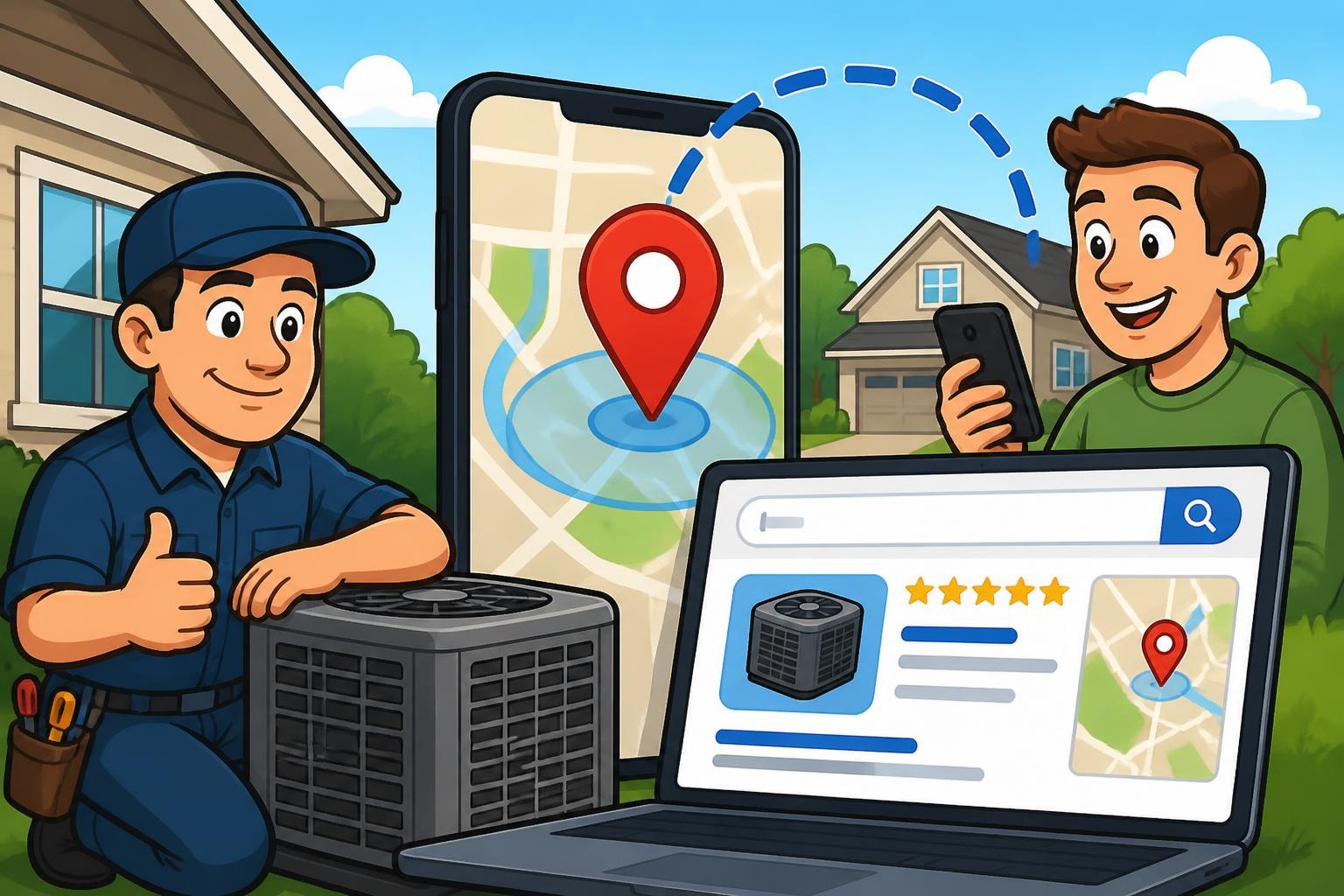
When your furnace breaks down at 2 AM on a freezing January night, where do you turn? Like 97% of homeowners, you probably grab your phone and search "emergency HVAC near me." That's the exact moment when local SEO for HVAC contractors makes all the difference between your business appearing at the top of search results or being invisible to desperate customers. In an industry where timing and proximity matter more than almost anything else, your local search visibility directly determines how many calls, bookings, and customers you'll earn this year.
Why Local SEO for HVAC Contractors Drives Real Business Growth
Local SEO isn't just marketing jargon. It's the digital version of having the best location on Main Street, except your "storefront" appears exactly when nearby homeowners need you most.
Here's what makes it essential for your HVAC business:
- Immediate intent: People searching for HVAC services need help now, not next month
- Geographic specificity: Your service area determines your customer base
- Mobile dominance: 76% of local searches happen on smartphones
- Conversion rates: Local searches convert 5X higher than general searches
The heating and cooling industry operates on emergency response and seasonal demand cycles. When someone's air conditioning fails during a heat wave, they're not browsing multiple websites. They're calling the first qualified contractor they find on Google.
The Revenue Impact of Local Visibility
Think about your service area. Whether you cover three townships or an entire county, there are hundreds of homeowners searching for HVAC services every single month. Missing those searches means losing customers to competitors who've invested in their local presence.
| Search Visibility | Monthly Calls | Yearly Revenue Impact |
|---|---|---|
| Page 2+ rankings | 5-10 calls | $15,000 – $30,000 |
| Bottom of Page 1 | 20-30 calls | $60,000 – $90,000 |
| Top 3 rankings | 50-80 calls | $150,000 – $240,000 |
These aren't hypothetical numbers. They represent real opportunities in your market right now.
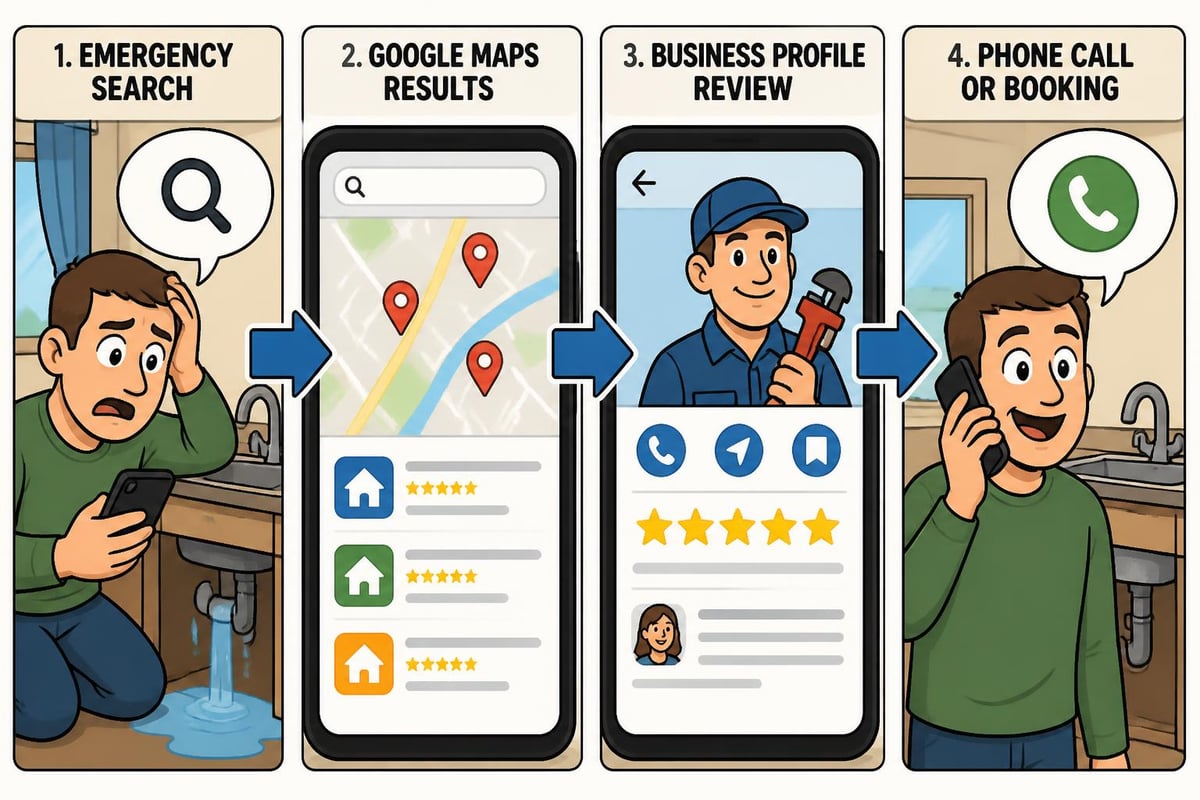
Google Business Profile Optimization: Your Digital Storefront
Your Google Business Profile (formerly Google My Business) is the single most important factor in local SEO for HVAC contractors. When someone searches "AC repair near me," Google pulls information directly from these profiles to populate the map pack (those three businesses shown with map pins).
Setting up your profile is just the starting point. Optimization is where the magic happens.
Essential Profile Elements
Business Name: Use your exact legal business name without keyword stuffing. "Smith HVAC" not "Smith HVAC Best AC Repair Heating Cooling."
Categories: Primary category should be "HVAC Contractor." Add secondary categories like "Air Conditioning Repair Service," "Heating Contractor," and "Air Duct Cleaning Service."
Service Area: Define your exact coverage zones. Be specific about which towns, zip codes, and neighborhoods you serve.
Business Description: You have 750 characters to explain what makes your HVAC company unique. Include your specialties, years in business, certifications, and service promise.
Your profile description might read: "Family-owned HVAC contractor serving Bucks County since 2001. We specialize in emergency furnace repair, AC installation, and preventive maintenance for residential and commercial properties. Our EPA-certified technicians respond within 2 hours for emergency calls and offer upfront pricing on all services."
Photos That Convert Browsers to Callers
Upload high-quality images every week. Google rewards active profiles with better visibility.
- Before/after installation photos
- Your uniformed technicians at work
- Company vehicles with clear branding
- Equipment you install (furnaces, AC units, thermostats)
- Your team and office location
Businesses with photos receive 42% more requests for directions and 35% more click-throughs to their websites compared to those without images.
Building Citation Consistency Across the Web
Citations are online mentions of your business name, address, and phone number (NAP). Maintaining NAP consistency across directories signals to Google that your business is legitimate and established.
Think of citations as votes of confidence. The more consistent citations you have, the more Google trusts your business information.
Where to Build HVAC Citations
Start with these foundational directories:
- Major platforms: Yelp, Facebook, BBB, Angi, HomeAdvisor
- Industry-specific: HVAC.com, ACCA directory, Carrier dealer locator
- Local directories: Chamber of Commerce, local business associations
- Data aggregators: Neustar Localeze, Factual, Infogroup
Every citation should have identical information. If your Google profile says "123 Main Street," don't write "123 Main St." elsewhere. Even small variations confuse search engines.
| Citation Factor | Impact on Rankings | Easy to Fix? |
|---|---|---|
| NAP consistency | High | Yes |
| Citation quantity | Medium | Moderate |
| Citation quality | High | Moderate |
| Industry-specific | Medium | Yes |
Creating Location-Specific Service Pages
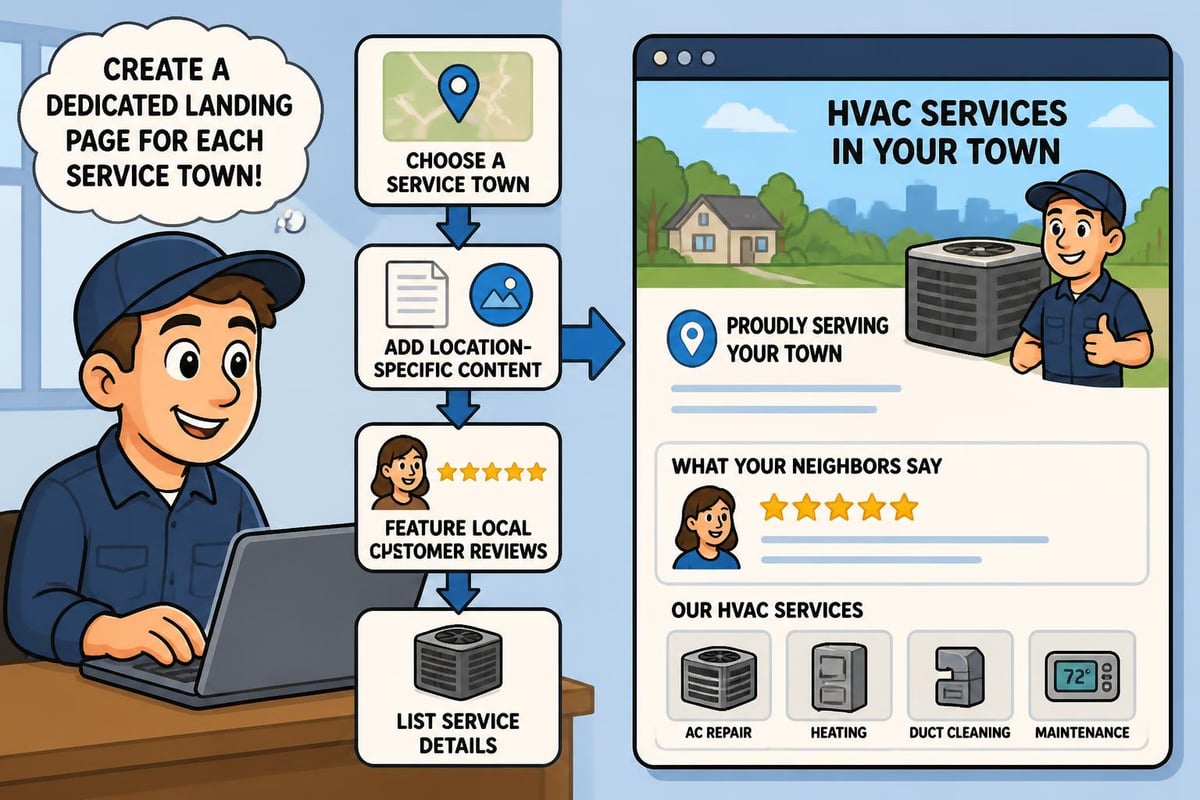
Generic service pages don't cut it anymore. Developing location-specific content for each town or neighborhood you serve dramatically improves your local search rankings.
Instead of one page titled "AC Repair," create dedicated pages for "AC Repair in Doylestown," "Air Conditioning Service in Newtown," and "Emergency AC Repair in Warrington."
What Belongs on Location Pages
Each location-specific service page should include:
- Service description: What you do and how you help local homeowners
- Local landmarks: Reference recognizable places, schools, or neighborhoods
- Service area specifics: Unique challenges in that area (older homes, specific zoning)
- Customer testimonials: Reviews from customers in that town
- Local phone number: If you have multiple locations or tracking numbers
- Embedded Google Map: Showing your relationship to that service area
A strong opening paragraph might say: "When Doylestown homeowners face AC breakdowns during summer heat waves, our certified technicians respond fast. We've serviced over 400 homes in the Doylestown area, from historic properties in the borough to newer developments near Central Bucks West High School."
This approach works because it speaks directly to local residents while incorporating geographic signals Google uses for ranking.
Review Generation and Management Strategy
Online reviews are the modern word-of-mouth referral system. For local SEO for HVAC contractors, reviews serve double duty: they influence rankings AND convince potential customers to choose you.
Google uses review signals in its ranking algorithm. Businesses with consistent, recent reviews rank higher than competitors with fewer or older reviews.
Building a Review System That Works
Most satisfied customers won't leave reviews unless you ask. Create a systematic approach:
Timing matters: Request reviews 24-48 hours after job completion when satisfaction is highest.
Make it easy: Send a direct link to your Google Business Profile review page via text or email.
Ask in person: Train technicians to mention: "If you're happy with our service, we'd really appreciate a Google review. I'll text you the link right now."
Follow up: Send one reminder if customers don't leave a review within a week.
You need both quantity and quality. Aim for 2-4 new reviews monthly at minimum. Businesses with 50+ reviews earn 50% more clicks than those with fewer reviews.
Responding to Every Review (Yes, Every Single One)
Thank positive reviewers by name and mention specific details about their service. When someone writes "Great job fixing our furnace," reply with "Thanks, Jennifer! We're glad we could get your heating system working before that cold snap hit. Stay warm!"
For negative reviews, respond professionally within 24 hours. Acknowledge concerns, offer to make things right, and take the conversation offline. Future customers judge you on how you handle problems, not whether problems exist.
Technical SEO Foundations for HVAC Websites
Your website's technical health impacts how well you rank locally. Even perfect content won't help if Google can't properly crawl and index your site.
Mobile Optimization is Non-Negotiable
With 60% of HVAC searches happening on mobile devices, your website must load quickly and function perfectly on smartphones.
Test your site speed at Google PageSpeed Insights. Aim for these targets:
- Load time: Under 3 seconds on 4G connections
- Largest Contentful Paint: Under 2.5 seconds
- First Input Delay: Under 100 milliseconds
Compress images, enable browser caching, and minimize code bloat. A one-second delay in page load time reduces conversions by 7%.
Schema Markup for HVAC Contractors
Schema markup is code that helps Google understand your business information. Implementing local business schema can earn you rich snippets in search results, including star ratings, pricing, and service areas.
Add LocalBusiness schema with these properties:
- Business name, address, phone
- Service areas (zip codes or cities)
- Services offered (furnace repair, AC installation, etc.)
- Business hours and emergency availability
- Aggregate rating from reviews
You don't need to be a developer to add schema. Many WordPress plugins handle this automatically, or your web team can implement it manually.
Content Marketing That Attracts Local Customers
Blog content serves multiple purposes for HVAC contractors. It demonstrates expertise, targets long-tail keywords, and provides value to potential customers researching their options.
Write about topics your customers actually search for:
- "How long should a furnace last?"
- "Signs your AC needs refrigerant"
- "When to replace vs. repair your heating system"
- "How to choose the right sized AC unit"
- "Ductless mini-split pros and cons"
Include local angles in your content. "Preparing Your HVAC System for Bucks County Winters" ranks better locally than generic seasonal advice.
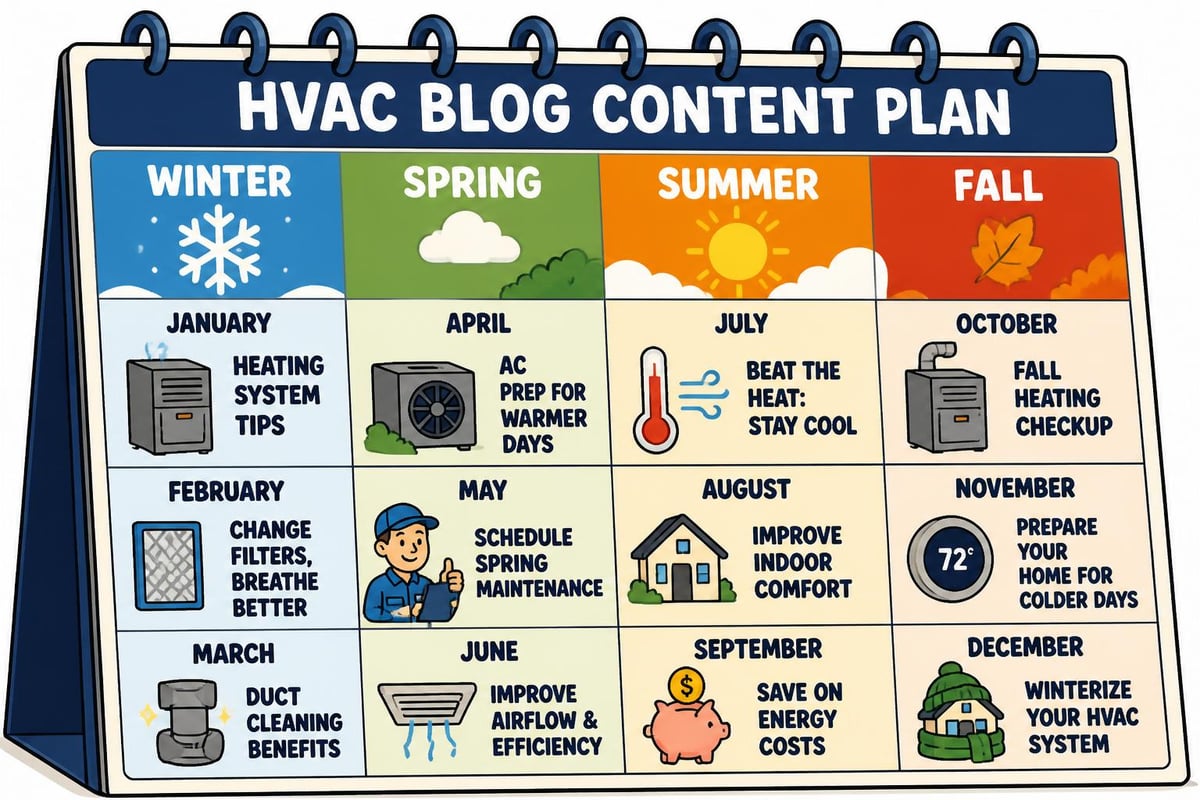
Seasonal Content Calendars
Plan content around your busy seasons:
Spring (March-May):
- AC tune-up checklists
- Benefits of spring HVAC maintenance
- How to prepare for summer heat
Summer (June-August):
- Emergency AC troubleshooting
- Signs your AC is failing
- Energy efficiency tips for hot weather
Fall (September-November):
- Furnace preparation guides
- When to schedule heating system service
- Thermostat upgrade benefits
Winter (December-February):
- Emergency heating repair info
- Carbon monoxide safety
- Winter energy savings strategies
Publishing 2-4 blog posts monthly keeps your website fresh and targets keywords you might not rank for with service pages alone. For comprehensive strategies across the contractor space, explore our guide to SEO for contractors.
Link Building for Local HVAC Authority
Backlinks from reputable local websites signal to Google that your business is trustworthy and established in your community.
Quality matters more than quantity. One link from your local chamber of commerce carries more weight than ten links from random directories.
Local Link Opportunities
- Sponsor local events: Little league teams, charity runs, school programs
- Partner with complementary businesses: Real estate agents, home builders, property managers
- Join professional associations: ACCA, local contractor groups, trade organizations
- Local media coverage: Offer expert quotes on HVAC topics to local news outlets
- Community involvement: Document your community service and partnerships
When a local newspaper writes about energy efficiency and quotes you as the HVAC expert, that's a valuable local link. When you sponsor the high school basketball team and they link to your website, that's a relevant local signal.
Leveraging Emergency and After-Hours Opportunities
HVAC emergencies happen outside business hours. Optimizing for these high-intent searches can fill your schedule with premium service calls.
Target these emergency keywords in your local SEO for HVAC contractors strategy:
- "24 hour HVAC repair near me"
- "Emergency furnace repair [city name]"
- "After hours AC service"
- "Same day heating repair"
Create dedicated landing pages for emergency services. Prominently display your 24/7 availability, response time guarantees, and emergency contact number. Many contractors miss this opportunity because they don't explicitly target emergency searchers.
Tracking Your Local SEO Performance
You can't improve what you don't measure. Set up tracking for these key metrics:
Essential KPIs to Monitor
Google Business Profile Insights:
- Search queries triggering your profile
- Direction requests
- Phone calls from your profile
- Website clicks
Website Analytics:
- Organic traffic from local searches
- Conversion rate for service area pages
- Call tracking numbers for attribution
- Form submissions by traffic source
Ranking Positions:
- Track rankings for key terms in each service city
- Monitor Map Pack positions
- Watch competitor movements
Monthly reporting helps you identify what's working and where to focus effort. If your Newtown AC repair page ranks well but your Doylestown furnace page doesn't, you know where to invest more content and optimization work.
Understanding your baseline performance helps you set realistic goals and measure improvement over time. For businesses just starting their local SEO journey, an Authority + AI Visibility Blueprint provides a clear roadmap of where you stand and exactly what steps will generate the most leads from Google and AI search platforms.

Competitive Analysis in Your Service Area
Your competitors aren't just other HVAC companies. They're anyone ranking above you in local search results for your target keywords.
What to Analyze
Study the top three competitors in your service area:
- Their Google Business Profile: How many reviews? How often do they post? What categories?
- Website structure: What location pages exist? How's their content organized?
- Backlink profile: What local organizations link to them?
- Content strategy: What blog topics do they cover?
- Customer engagement: How do they respond to reviews?
This research reveals gaps in your strategy and opportunities your competitors haven't claimed yet. If you serve Warrington but none of your competitors have a dedicated Warrington service page, that's an easy win.
Tools like Google Search Console, BrightLocal, and Semrush can automate much of this competitive intelligence. For home service businesses looking to expand their digital presence, our SEO for home services programs include detailed competitive analysis.
Common Local SEO Mistakes HVAC Contractors Make
Even experienced contractors sabotage their rankings with these preventable errors:
Inconsistent business information: Using different phone numbers or addresses across platforms confuses Google and dilutes your authority.
Ignoring negative reviews: Unanswered complaints signal poor customer service to both Google and potential customers.
Duplicate content: Copying the same service description across all location pages triggers duplicate content penalties.
Missing service area definitions: Not specifying which towns you serve leaves Google guessing about your relevance.
No mobile optimization: Forcing mobile users to pinch and zoom guarantees they'll click back to a competitor.
Keyword stuffing: Cramming "HVAC contractor" into every sentence reads poorly and Google penalizes it.
Neglecting Google Posts: The businesses posting weekly updates consistently outrank those that don't.
Following established local SEO best practices helps avoid these pitfalls and maintain steady ranking improvements.
The Role of Social Media in Local Visibility
While social signals don't directly impact rankings, social media supports your local SEO for HVAC contractors efforts in multiple ways.
Facebook and Instagram provide additional touchpoints where potential customers discover your business. When someone searches for your company name after seeing your truck or a friend's recommendation, your social profiles appear alongside your website and Google listing.
Social Media Best Practices
- Claim and complete all profiles: Facebook, Instagram, LinkedIn, even Pinterest
- Match your business information: Same NAP details as everywhere else
- Share customer success stories: Before/after photos of installations
- Engage with local community pages: Answer questions in local groups
- Promote reviews: Share positive Google reviews on social platforms
Social engagement also generates brand searches. When people specifically search "Smith HVAC Doylestown," that branded traffic signals to Google that your business is relevant and trusted in that location.
Voice Search Optimization for HVAC Services
With the rise of Alexa, Siri, and Google Assistant, voice search accounts for 27% of all mobile searches. People asking their devices "Who does furnace repair near me?" expect immediate, relevant answers.
Voice searches tend to be longer and more conversational than typed queries. Instead of "AC repair Newtown," voice searchers ask "Where can I find someone to fix my air conditioner in Newtown today?"
Optimizing for Voice Search
Create FAQ pages answering common questions in natural language:
- "How much does a new furnace cost?"
- "What's the best type of air conditioner for my home?"
- "How often should I change my air filter?"
- "Who fixes heaters in [your town]?"
Structure your answers in concise paragraphs that voice assistants can easily extract as featured snippets. Starting answers with "The typical cost of…" or "Most HVAC experts recommend…" increases your chances of being selected as the voice search result.
Integrating Paid and Organic Local Strategies
Local SEO for HVAC contractors works best when complemented by targeted local ads. While you build organic rankings (which takes 3-6 months), Google Local Services Ads and paid search can generate immediate calls.
This integrated approach provides continuous visibility:
- Google Local Services Ads: Pay-per-lead for screened and verified contractors
- Google Ads: Target specific services and locations with immediate results
- Organic SEO: Long-term visibility without per-click costs
Many successful HVAC contractors run ads for competitive emergency keywords while relying on organic rankings for scheduled maintenance and installations. The combination maximizes your market coverage while controlling costs.
Your organic efforts also improve ad performance. Higher Quality Scores from strong landing pages reduce your cost-per-click, making paid campaigns more profitable.
Long-Term Local SEO Maintenance
Local SEO isn't a one-time project. It requires ongoing attention to maintain and improve rankings as Google's algorithms evolve and competitors raise their game.
Monthly Maintenance Checklist
- Review and respond to all new reviews
- Publish 1-2 Google Business Profile posts
- Add 2-4 new photos to your profile
- Publish 2-3 blog posts
- Check citation accuracy across major directories
- Monitor rankings for key local terms
- Analyze traffic and conversion data
- Update seasonal content
Quarterly tasks include:
- Comprehensive citation audit
- Backlink analysis and new link outreach
- Competitor ranking review
- Service area page updates
- Schema markup verification
This consistent effort compounds over time. The HVAC contractor who publishes quality content monthly for a year has 24-48 pages targeting local keywords, while competitors who post sporadically might have five.
Implementing comprehensive SEO strategies requires dedication, but the payoff in sustainable lead generation justifies the investment.
Dominating local search results isn't complicated, but it does require a strategic, consistent approach across multiple ranking factors. When you optimize your Google Business Profile, build consistent citations, create location-specific content, and earn quality reviews, you position your HVAC business as the go-to choice in your service area. With over two decades of experience helping home service businesses grow their online visibility, Shawn the SEO Geek specializes in creating customized local SEO strategies that generate real calls and booked appointments. Ready to dominate your local HVAC market? Let's build your roadmap to the top of search results.