
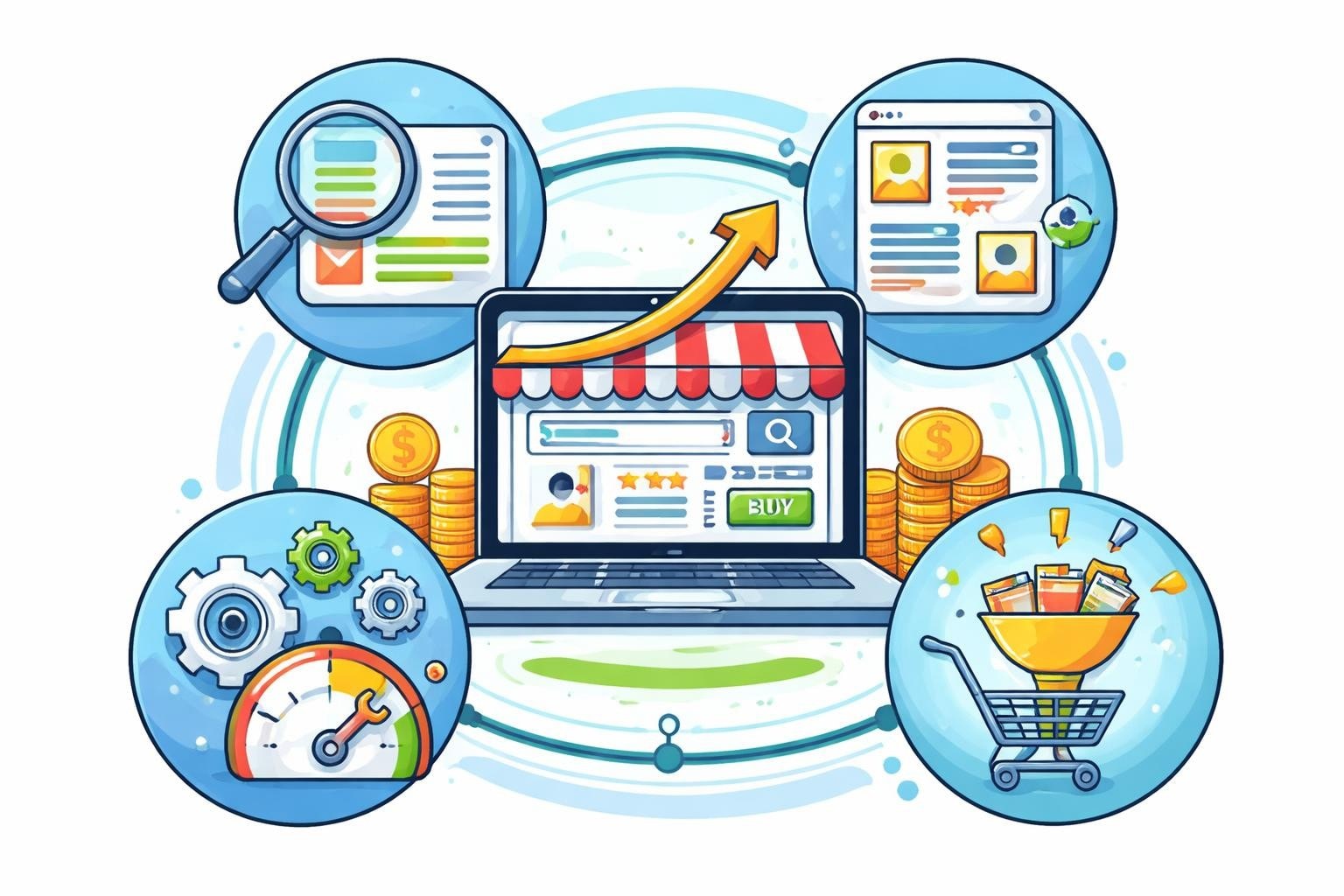
Running an online store in 2026 means competing with millions of other businesses for customer attention. While paid ads can bring quick results, mastering SEO in e commerce creates a sustainable foundation for long-term growth. When shoppers search for products you sell, your site needs to appear at the top of search results-not buried on page three. The good news? With the right approach, you can build organic visibility that drives consistent traffic and sales month after month.
Understanding Why SEO in E Commerce Differs from Regular SEO
E commerce SEO isn't just regular SEO applied to an online store. The challenges are unique and the stakes are higher.
Traditional websites might have 20 to 50 pages, but online stores often manage hundreds or thousands of product pages. Each one needs optimization. You're also dealing with inventory changes, seasonal products, and category structures that regular business sites don't face.
Search intent matters differently too. When someone searches for "digital marketing tips," they want information. When they search for "women's running shoes size 8," they're ready to buy. Understanding this transactional intent shapes everything about how you approach optimizing your ecommerce website.
The Unique Challenges E Commerce Sites Face
Online stores battle several SEO obstacles simultaneously:
- Duplicate content from manufacturer descriptions used across multiple retailers
- Thin content on product pages with minimal unique information
- Site structure complexity with layered category navigation
- Inventory fluctuations creating orphaned pages when products go out of stock
- Pagination issues across category pages with hundreds of products
Each challenge requires specific solutions. You can't just write a few blog posts and call it a day.
Building a Strong Technical Foundation
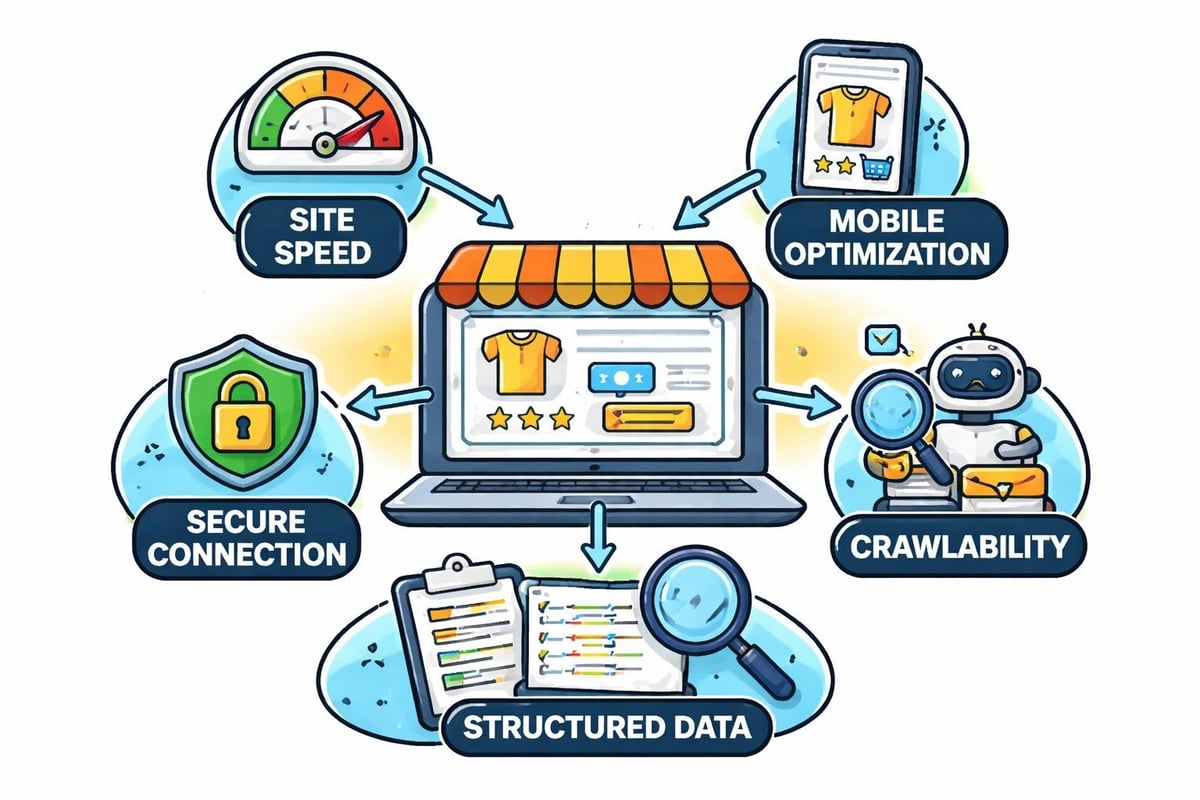
Technical SEO forms the bedrock of successful e commerce visibility. Without it, even the best content won't rank.
Your site speed directly impacts both rankings and conversions. Studies show that a one-second delay in page load time can reduce conversions by 7%. For an online store doing $100,000 monthly, that's $7,000 left on the table.
| Technical Element | Impact on SEO | Impact on Sales |
|---|---|---|
| Page Load Speed | High (ranking factor) | Critical (affects bounce rate) |
| Mobile Responsiveness | Critical (mobile-first indexing) | Essential (60%+ mobile shoppers) |
| SSL Certificate | Required (ranking signal) | Mandatory (trust factor) |
| Structured Data | Significant (rich snippets) | High (click-through boost) |
| XML Sitemap | Important (crawl efficiency) | Indirect (through visibility) |
Implementing Structured Data for Product Pages
Structured data markup tells search engines exactly what information appears on your product pages. This creates those eye-catching rich snippets that show star ratings, prices, and availability right in search results.
Google’s ecommerce documentation outlines the specific schema markup types online stores should implement. Product schema, review schema, and breadcrumb markup are essential starting points.
When you add proper structured data, you're not just hoping for better rankings. You're directly improving your click-through rates by making your listings more attractive and informative than competitors.
Mastering Product Page Optimization
Product pages are where SEO in e commerce either succeeds or fails. These pages need to rank AND convert.
Start with unique, compelling product descriptions. Copying manufacturer content is the fastest way to disappear in search results. Write descriptions that answer customer questions, highlight benefits, and naturally incorporate keywords.
Crafting Product Titles That Rank and Convert
Your product title serves double duty-it needs to appeal to search algorithms and human shoppers simultaneously.
Include these elements in your product titles:
- Primary keyword (what people actually search for)
- Brand name (if it's a known brand)
- Key specifications (size, color, model number)
- Unique selling point (if space allows)
For example: "Sony WH-1000XM5 Wireless Noise Cancelling Headphones – Black" works better than "Premium Headphones – Best Sound Quality."
The formula balances SEO value with clarity. Don't keyword stuff-make it readable first, optimized second.
Image Optimization That Drives Traffic
Product images do more than showcase your items. They're search ranking opportunities.
Every image needs:
- Descriptive file names (not IMG_8472.jpg)
- Alt text that describes the product
- Compressed file size for fast loading
- Multiple angles and views
Your alt text should be specific: "Red leather crossbody bag with gold chain strap" instead of just "handbag." This helps with both accessibility and image search rankings, which according to best practices can drive significant qualified traffic to product pages.
Category Pages and Site Architecture
Your site structure either helps or hinders both users and search engines. Think of it as the roadmap to all your products.
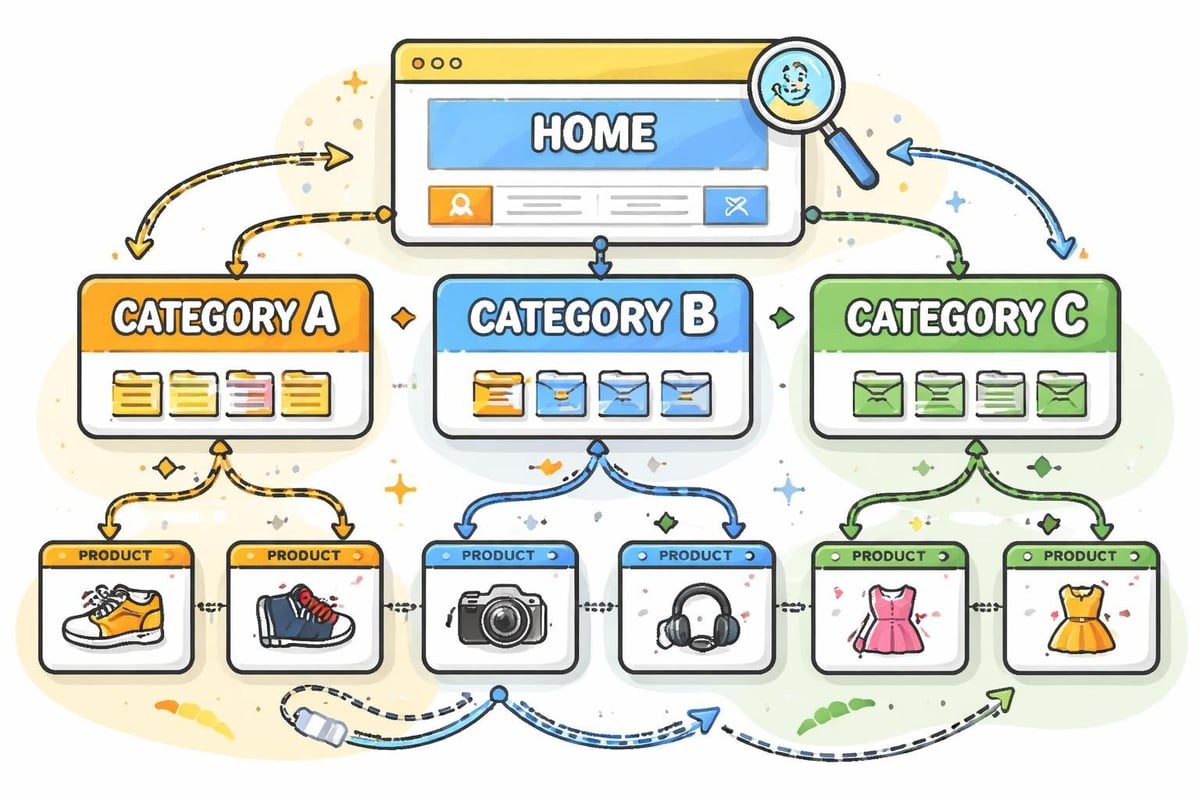
Flat architecture works better than deep nesting. Shoppers should reach any product within three clicks from the homepage. This improves user experience and helps search engines crawl your entire catalog efficiently.
Internal Linking Strategies That Boost Rankings
Smart internal linking distributes authority throughout your site and keeps shoppers browsing longer.
Link from:
- Category pages to subcategories and featured products
- Product pages to related items and complementary products
- Blog content to relevant category and product pages
- Homepage to top-performing categories
The key is making links contextual and natural. "Shop our waterproof hiking boots" provides more value than "click here." This approach mirrors the strategies we use for service-based businesses, adapted for product catalogs.
| Linking Strategy | Primary Benefit | Implementation Difficulty |
|---|---|---|
| Related Products | Increases average order value | Easy |
| Category Cross-Links | Distributes page authority | Medium |
| Blog to Product Links | Captures informational searches | Easy |
| Breadcrumb Navigation | Improves site structure | Medium |
Content Marketing for E Commerce Success
Product pages alone won't capture all the search traffic available to your store. Content marketing fills the gap.
Create content that answers questions shoppers ask before they're ready to buy. Buying guides, comparison articles, and how-to content attract visitors in the research phase.
Building a Content Strategy That Drives Sales
Your content should map to different stages of the buyer journey:
Awareness stage: Educational content about problems your products solve
Consideration stage: Comparison guides and feature explanations
Decision stage: Detailed product reviews and testimonials
Each piece should naturally link to relevant category or product pages. You're not writing content for content's sake-you're building pathways to purchases.
Looking at successful ecommerce SEO case studies reveals that stores investing in comprehensive content marketing see traffic increases of 50% to 200% within 12 months.
Keyword Research for Product Discovery
Understanding what your customers actually search for makes the difference between wasted effort and profitable rankings.
Don't assume you know the terminology. Research reveals surprising patterns. People might search for "sneakers" more than "athletic shoes" or vice versa depending on your niche.
Finding High-Intent Commercial Keywords
Focus on keywords that signal buying intent rather than just browsing:
- Product + Review searches show people comparing options
- Product + Best indicates readiness to purchase
- Product + [Location] signals local buying intent
- Product + Buy/Purchase shows immediate purchase intent
Tools like those reviewed in the best SEO tool roundups help identify these opportunities. But don't ignore your own site search data-it reveals exactly what your visitors want.
Long-tail keywords convert better than broad terms. "Waterproof hiking boots for women size 8" brings more qualified traffic than just "boots."
Mobile Optimization for E Commerce
More than 60% of online shopping happens on mobile devices in 2026. Your mobile experience directly impacts your rankings and revenue.
Google uses mobile-first indexing, meaning it primarily looks at your mobile site for ranking purposes. If your mobile site is slow or difficult to use, you're sacrificing visibility.
Mobile-Specific SEO Considerations
Tap targets need adequate spacing. When "Add to Cart" buttons are too close to other elements, frustrated shoppers leave.
Page speed matters even more on mobile. Compress images aggressively, minimize redirects, and leverage browser caching.
Simplified navigation helps mobile shoppers find products quickly. Hamburger menus work well, but make category access intuitive. Test your navigation with actual users on various devices.
Following comprehensive SEO strategies for websites becomes even more critical when optimizing for mobile-first indexing.
Managing Out-of-Stock and Seasonal Products
Inventory changes create unique SEO challenges. How you handle discontinued or seasonal products affects your long-term rankings.
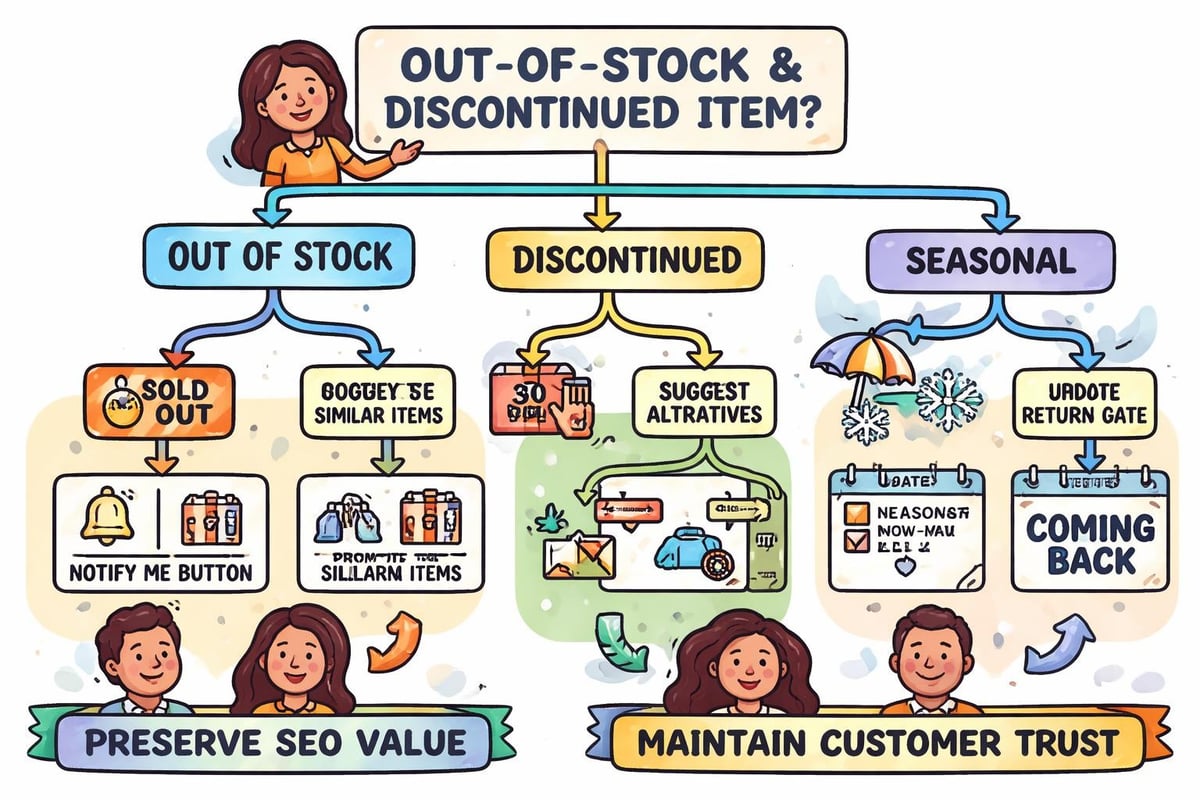
Never delete product pages that have earned rankings and backlinks. Instead:
- If temporarily out of stock: Keep the page live with expected restock dates
- If permanently discontinued: 301 redirect to the closest similar product
- If seasonal: Keep the page live year-round with clear seasonal availability
This preserves the SEO value you've built while maintaining a positive user experience.
301 Redirects and Authority Preservation
When products genuinely disappear from your catalog, strategic redirects prevent dead ends and preserve link equity.
Redirect to the most relevant alternative-same category, similar features, or comparable price point. Sending shoppers to unrelated products frustrates them and wastes the ranking power that page accumulated.
Monitor your redirects regularly. Chains of redirects (A→B→C) slow down your site and dilute authority. Clean them up periodically.
User-Generated Content and Reviews
Customer reviews do double duty for SEO in e commerce. They build trust AND create fresh, unique content that search engines love.
Products with reviews typically rank higher than identical products without them. Reviews naturally include the long-tail keywords real customers use-phrases you might never think to optimize for.
Actively encourage reviews through:
- Post-purchase email sequences
- Incentive programs (within platform guidelines)
- Making the review process simple and mobile-friendly
- Responding to reviews to show engagement
Review schema markup makes star ratings appear in search results, dramatically improving click-through rates. A product showing 4.7 stars gets more clicks than the same product without visible ratings.
Link Building for Online Stores
Backlinks remain a powerful ranking factor. But building links to product pages is harder than linking to content.
Focus on linkable assets that naturally attract attention:
- Original research or industry reports
- Comprehensive buying guides that become resources
- Tools or calculators relevant to your products
- Visual content like infographics showing data or processes
Digital PR works exceptionally well for e commerce. Get featured in gift guides, "best of" lists, and industry roundups. These placements often include links to category or product pages.
Building relationships with bloggers and influencers in your niche creates ongoing link opportunities. When they review products or create content about your industry, your store becomes a natural reference point.
Platform-Specific SEO Considerations
Your choice of ecommerce platform impacts your SEO capabilities. Different platforms offer varying levels of control over SEO elements.
Shopify provides solid out-of-the-box SEO but has some limitations on URL structure. For businesses serious about Shopify optimization, working with specialists who understand the platform's nuances-like those offering Shopify SEO services-can unlock significant advantages.
WooCommerce offers maximum flexibility since it's built on WordPress. You control everything, but that means you're also responsible for everything.
BigCommerce includes robust SEO features natively, with good control over meta tags, URLs, and redirects.
Whatever platform you choose, ensure it allows you to:
- Customize URLs for all pages
- Edit meta titles and descriptions
- Add structured data
- Create XML sitemaps automatically
- Implement 301 redirects easily
Measuring E Commerce SEO Success
Tracking the right metrics reveals what's working and what needs adjustment. Revenue matters more than rankings alone.
| Metric | What It Reveals | Target Frequency |
|---|---|---|
| Organic Traffic | Overall visibility growth | Weekly |
| Organic Revenue | Actual business impact | Weekly |
| Conversion Rate by Landing Page | Which pages convert best | Monthly |
| Keyword Rankings | Competitive position | Bi-weekly |
| Product Page Engagement | User experience quality | Monthly |
| Backlink Growth | Authority building progress | Monthly |
Organic traffic shows whether your visibility is improving. But traffic without sales is meaningless.
Conversion rate by organic landing page reveals which pages turn visitors into customers. Low-converting pages with high traffic need optimization work.
Keyword rankings provide early signals before traffic changes appear. Tracking both category-level keywords and product-specific terms gives you complete visibility.
Don't obsess over individual keyword positions. Focus on overall organic revenue growth-that's the metric that matters to your business.
Advanced Strategies for Competitive Markets
When you're competing in crowded markets, basic optimization isn't enough. You need advanced tactics that create separation from competitors.
Topical authority means dominating a specific product category with comprehensive coverage. Don't spread yourself thin across hundreds of categories-own a few completely. Create extensive content around those categories, covering every question and angle.
FAQ schema on product and category pages captures featured snippets and "People Also Ask" placements. These positions provide visibility above traditional organic results.
Video content for products creates additional search presence. Product videos rank in both regular search and video search, giving you multiple opportunities to be found. Host videos on your own site (not just YouTube) to keep traffic on your domain.
Understanding where your business currently stands requires thorough analysis. Sometimes getting an outside perspective through professional SEO website audit services reveals opportunities you've been missing and technical issues holding back your rankings.
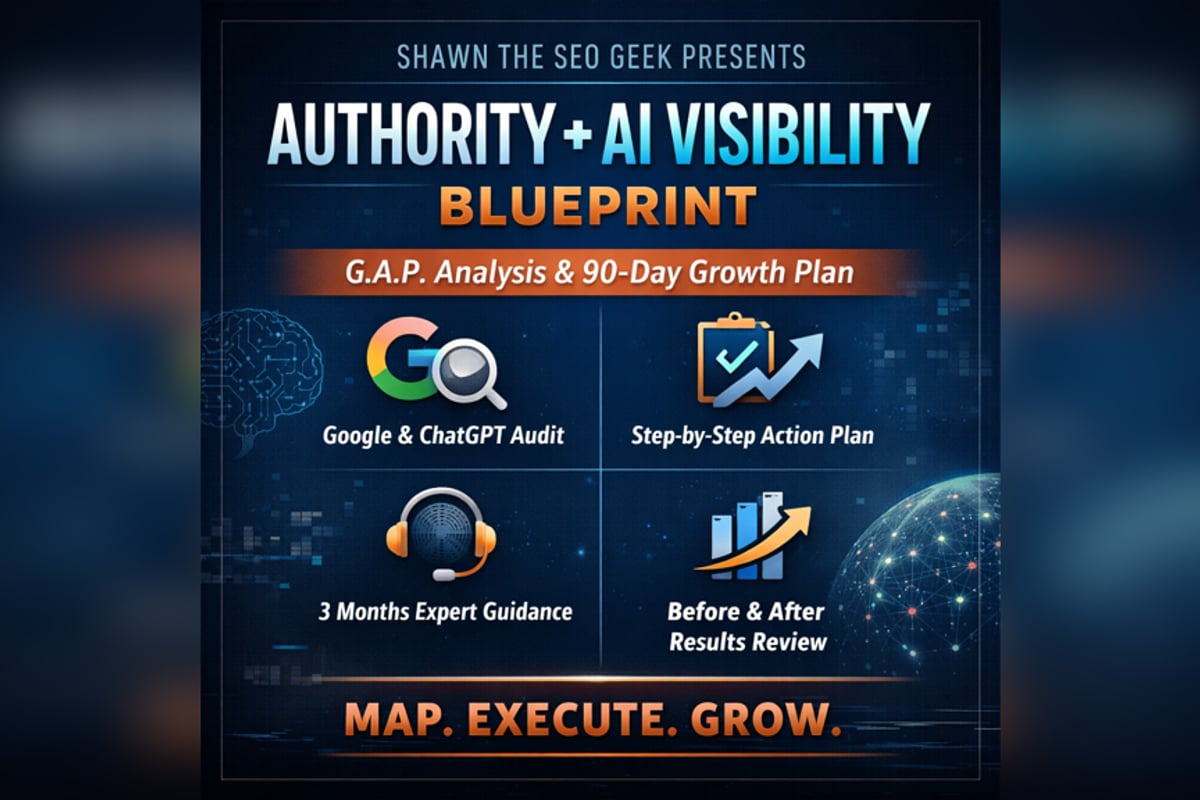
If you're looking to establish a strong foundation quickly, having a clear roadmap makes all the difference. The Authority + AI Visibility Blueprint provides exactly that-a comprehensive audit of your current search presence followed by a strategic roadmap showing how to rank for keywords that generate actual leads and sales.
Local SEO for E Commerce Stores
Even pure online retailers can benefit from local SEO if they target specific geographic markets or have physical locations.
Google Business Profile listings help if you have a showroom or offer local pickup. Optimize your profile completely with categories, photos, posts, and regular updates.
Local keywords like "buy [product] in [city]" capture location-specific searches. These often convert better because the searcher has local intent and urgency.
Creating location-specific landing pages works when you target multiple markets. Just ensure each page has unique, valuable content-not thin, duplicated text with only the city name changed.
The Role of User Experience in SEO Rankings
Google's algorithm increasingly prioritizes user experience signals. Core Web Vitals measure loading performance, interactivity, and visual stability.
Improving Core Web Vitals directly impacts rankings:
- Largest Contentful Paint (LCP) should occur within 2.5 seconds
- First Input Delay (FID) should be less than 100 milliseconds
- Cumulative Layout Shift (CLS) should be less than 0.1
Beyond technical metrics, actual user behavior matters. High bounce rates and short dwell times signal poor user experience, potentially harming your rankings.
Make your product pages genuinely helpful. Answer questions, provide detailed specifications, show multiple images, and make the purchase process frictionless. When users find what they need quickly and complete purchases easily, engagement metrics improve-and so do your rankings.
Staying Ahead of E Commerce SEO Trends
The search landscape evolves constantly. What worked in 2024 might not work in 2026, and strategies will continue shifting.
AI-powered search is changing how people discover products. ChatGPT and similar tools now provide product recommendations directly. Optimizing for AI search means ensuring your product information is clear, structured, and authoritative. Modern ecommerce SEO practices increasingly focus on how AI systems interpret and recommend products.
Voice search continues growing. Optimize for conversational queries and question-based searches. People speak differently than they type, using more natural language patterns.
Visual search lets shoppers find products by uploading images. Optimizing product images with detailed metadata and implementing visual search functionality creates competitive advantages.
Stay informed by following industry publications, testing new tactics on less critical pages, and monitoring what successful competitors implement. The stores that win in 2026 and beyond are those that adapt quickly while maintaining strong fundamentals.
Creating a Sustainable E Commerce SEO Strategy
Quick wins feel good, but sustainable growth requires systematic approaches. Build processes, not one-time optimizations.
Monthly optimization cycles keep your site improving consistently:
- Identify underperforming product or category pages
- Analyze why they're underperforming (technical issues, content gaps, poor UX)
- Implement fixes and enhancements
- Track results and document what works
- Apply successful tactics to similar pages
Content calendars ensure regular fresh content publication. Plan seasonal content months in advance so it ranks before peak shopping periods.
Competitive monitoring reveals opportunities and threats. When competitors launch new categories or content strategies, evaluate whether similar approaches fit your business.
Real-world examples from successful ecommerce SEO case studies demonstrate that stores implementing systematic, ongoing optimization see compounding results over time-often doubling or tripling organic traffic within 12-18 months.
Integration with Other Marketing Channels
SEO in e commerce doesn't exist in isolation. It works best when integrated with your other marketing efforts.
Email marketing data reveals what products and categories interest your audience. Use these insights to prioritize SEO efforts on high-interest items.
Paid search keyword data shows which terms convert best. Target these with SEO for long-term organic visibility after testing profitability through ads.
Social media content can be repurposed as blog content, creating SEO value from existing creative work. Customer questions on social platforms reveal content gaps your blog should address.
When all channels work together, sharing data and insights, your overall marketing efficiency improves dramatically. SEO provides the foundation that makes other channels more effective.
Mastering SEO in e commerce requires balancing technical excellence, compelling content, and outstanding user experience-but the rewards of sustainable organic growth make it worth the effort. Whether you're launching a new online store or scaling an established brand, having expert guidance ensures you're investing time and resources in strategies that actually drive sales. Shawn the SEO Geek brings over two decades of specialized experience helping e commerce businesses dominate search results and increase conversions through tailored, results-driven SEO strategies. Ready to transform your organic visibility and turn search traffic into consistent revenue? Let's build your roadmap to e commerce SEO success.