

When potential clients need legal help, they turn to Google. And if your law firm isn't showing up in local search results, you're missing out on qualified leads who are ready to hire. Law firm local seo has become the most critical marketing channel for attorneys who want to grow their practice and dominate their geographic market. Unlike traditional advertising, local SEO puts you in front of people actively searching for your services right when they need them most. The best part? Once you've optimized your local presence, it continues working for you 24/7, bringing in a steady stream of new clients without ongoing ad spend.
Why Law Firm Local SEO Matters More Than Ever
The legal industry has fundamentally changed. Clients no longer flip through the Yellow Pages or ask friends for recommendations as their first step. They search on their phones. In fact, nearly 93% of online experiences begin with a search engine, and "near me" searches have increased by over 500% in recent years.
For law firms, this shift creates an enormous opportunity. When someone searches for "personal injury lawyer near me" or "divorce attorney in Philadelphia," they're showing high commercial intent. They need help now, not next month.

The Competitive Landscape in 2026
Here's what makes law firm local seo particularly challenging:
- High competition: Multiple firms compete for the same local keywords
- Expensive PPC costs: Legal keywords can cost $100+ per click
- Trust requirements: Clients need to feel confident before reaching out
- Location-specific intent: Each neighborhood or city requires targeted optimization
That's why mastering local SEO isn't optional anymore. It's the foundation of sustainable law firm growth.
Understanding the Law Firm Local SEO Ecosystem
Local SEO for law firms operates differently than traditional SEO. You're not just trying to rank for broad keywords. You need to dominate specific geographic areas for specific practice areas. This requires a multi-channel approach that touches every aspect of your online presence.
The three pillars of law firm local seo include:
- Google Business Profile optimization (formerly Google My Business)
- Local citation building and management
- Location-specific website content and technical SEO
Each pillar supports the others, creating a synergistic effect that boosts your visibility across Google Maps, local pack results, and organic search results.
How Google Evaluates Local Law Firms
Google uses hundreds of ranking factors, but for local results, three stand out:
| Ranking Factor | What It Means | Why It Matters |
|---|---|---|
| Relevance | How well your listing matches the search query | Proper categorization and keyword optimization |
| Distance | How close you are to the searcher | Physical location and service area settings |
| Prominence | How well-known and trusted your firm is | Reviews, citations, links, and online mentions |
Understanding these factors helps you prioritize your law firm local seo efforts for maximum impact.
Optimizing Your Google Business Profile
Your Google Business Profile is the single most important element of your local SEO strategy. When optimized correctly, it can drive significant increases in client interactions, as one firm discovered when they achieved a 66% boost in profile engagement.
Essential GBP Optimization Steps
Start with these fundamental optimizations:
- Choose the right primary category: "Attorney" or your specific practice area
- Add all relevant secondary categories: Up to 9 additional categories
- Write a keyword-rich business description: Include practice areas and locations
- Upload high-quality photos: Office, team, and professional headshots
- Set accurate service areas: Define exactly where you practice
- Complete every attribute: Consultation options, languages, accessibility
Your business name should be consistent across all platforms. NAP consistency (Name, Address, Phone) is crucial for local rankings, as proper citation management directly impacts how Google validates your business information.
The Power of Google Posts and Q&A
Don't overlook these engagement features. Google Posts let you share updates, events, and offers directly in your profile. They signal freshness and activity to Google while giving potential clients more reasons to choose your firm.
The Q&A section requires proactive management. Seed it with common questions and answers about your practice. Monitor it regularly, as anyone can post questions (including competitors trying to make you look bad).
Building a Rock-Solid Citation Foundation
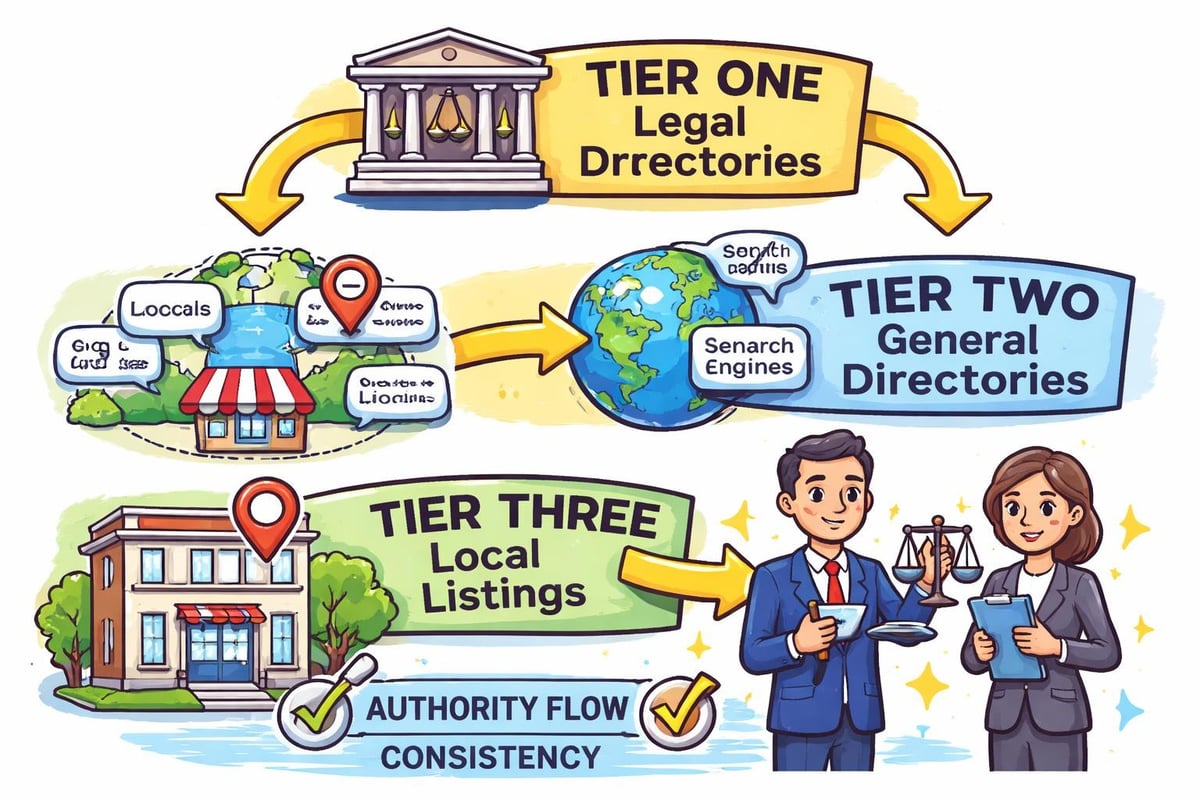
Citations are online mentions of your law firm's name, address, and phone number. They validate your business information across the web and build trust signals that Google uses to verify your legitimacy.
Primary Citation Sources for Law Firms
Focus on these high-authority directories first:
- Legal-specific directories (Avvo, Justia, FindLaw, Lawyers.com)
- General business directories (Yelp, Facebook, Better Business Bureau)
- Local chambers of commerce and bar associations
- Industry-specific platforms relevant to your practice areas
Quality matters more than quantity. One citation on a high-authority legal directory carries more weight than ten citations on obscure directories. For those looking to compare local SEO services, understanding citation quality benchmarks is essential.
Maintaining NAP Consistency
Consistency is everything. Your business information must match exactly across all platforms. Even small variations can confuse Google and dilute your local SEO efforts.
Common consistency mistakes to avoid:
- Using "Street" in some listings and "St." in others
- Listing different phone numbers on different platforms
- Including suite numbers inconsistently
- Varying your firm name format
Create a master document with your exact NAP information and reference it every time you create or update a listing.
Creating Location-Specific Website Content
Your website is the hub of your law firm local seo strategy. While citations and your GBP drive visibility, your website converts visitors into clients. Comprehensive law firm SEO strategies emphasize the importance of creating dedicated pages for each location and practice area combination.
Building Effective Location Pages
If you serve multiple cities or have multiple offices, each location needs its own dedicated page. These shouldn't be thin, templated content. Each page should include:
- Unique, valuable content about serving clients in that specific area
- Local landmarks and geographic references to establish relevance
- Embedded Google Map showing your office or service area
- Location-specific testimonials and case results (if applicable)
- Local contact information and directions
- Schema markup identifying the location
Many firms make the mistake of creating nearly identical location pages with just the city name swapped out. Google recognizes this and may not rank those pages well. Invest in creating genuinely unique content for each location you serve.
Practice Area Optimization for Local Search
Your practice area pages need local optimization too. Instead of just a "Personal Injury" page, create pages targeting "Personal Injury Lawyer in [City]" that discuss local laws, court systems, and community-specific considerations.
This approach works especially well for lawyers specializing in SEO, as it demonstrates deep local expertise while capturing long-tail search traffic.
Mastering Online Reviews and Reputation
Reviews are the lifeblood of law firm local seo. They influence both Google rankings and consumer trust. In fact, reviews are one of the top three ranking factors for local search results.
The Review Generation System
Don't wait for reviews to happen organically. Build a systematic approach:
| Step | Action | Timing |
|---|---|---|
| 1 | Identify satisfied clients | After case resolution |
| 2 | Send personalized review request | Within 1-2 weeks of completion |
| 3 | Provide direct link to review platform | Make it easy with one click |
| 4 | Follow up once if no response | 5-7 days later |
| 5 | Thank reviewers publicly | Within 24 hours of review |
The key is making it effortless for clients to leave reviews. Send them a direct link to your Google Business Profile review section. Every extra click reduces response rates dramatically.
Responding to Reviews (Positive and Negative)
Every review deserves a response. Positive reviews should be acknowledged with genuine appreciation. Thank the client by name (if appropriate), reference specific details from their review, and reinforce your firm's values.
Negative reviews require a different approach. Respond quickly, professionally, and empathetically. Never get defensive or argue. Acknowledge their concern, offer to discuss offline, and demonstrate to future clients that you handle problems with grace.
For firms facing reputation challenges, working with an online reputation agency can help develop comprehensive strategies to improve and protect your online image.
Technical SEO Fundamentals for Law Firm Websites
Local visibility depends on solid technical foundations. Your law firm local seo efforts will fall flat if your website has technical issues that prevent Google from crawling, understanding, or ranking your content.
Mobile Optimization Is Non-Negotiable
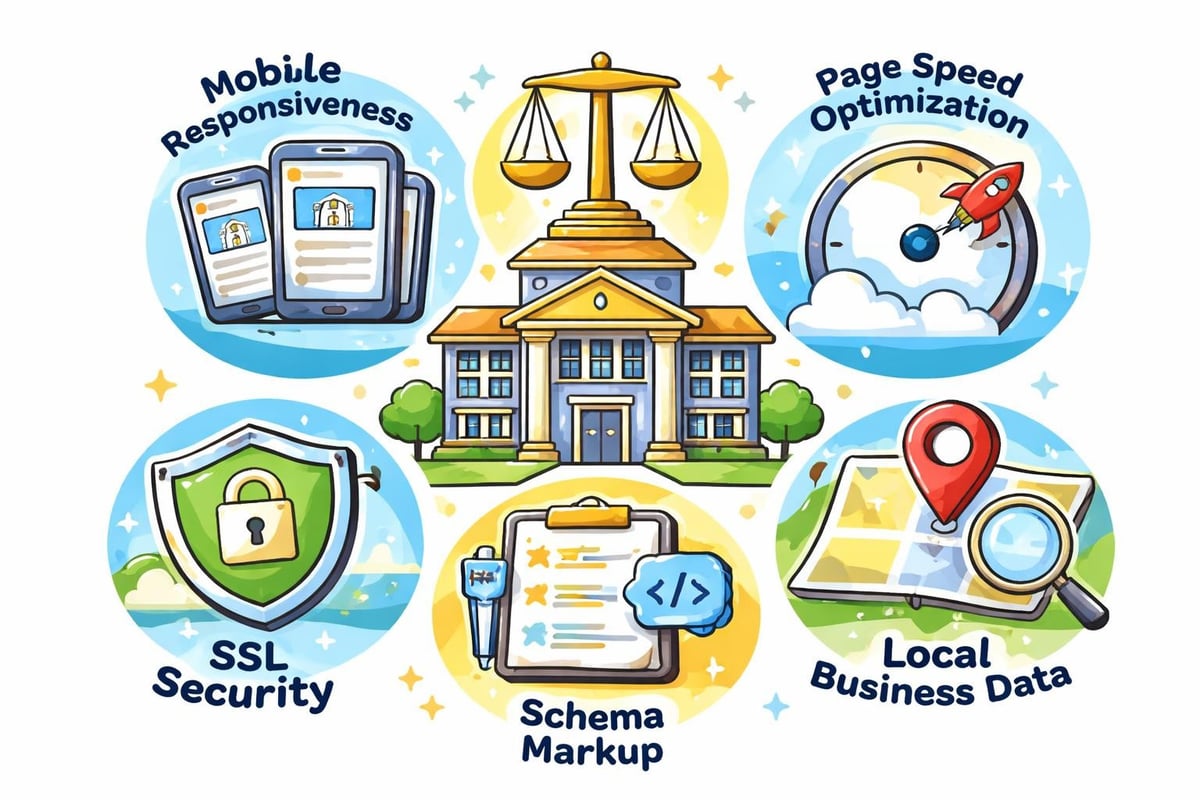
Over 60% of local searches happen on mobile devices. If your website isn't mobile-friendly, you're losing potential clients before they even read your content.
Essential mobile optimizations include:
- Responsive design that adapts to all screen sizes
- Fast loading speed (under 3 seconds ideal)
- Tap-friendly buttons and navigation
- Readable text without zooming
- Click-to-call phone numbers throughout the site
Test your site on actual mobile devices, not just desktop responsive preview modes. Real-world experience matters.
Schema Markup for Legal Websites
Schema markup is code that helps search engines understand your content better. For law firms, implementing LocalBusiness schema and LegalService schema can enhance how your firm appears in search results.
Key schema elements to implement:
- Organization/LocalBusiness schema with NAP information
- Attorney schema for individual lawyers
- Review schema to display star ratings in search
- Service area schema to define geographic coverage
- FAQ schema for common legal questions
While schema doesn't directly boost rankings, it improves click-through rates by making your listings more informative and visually appealing.
Link Building Strategies That Actually Work
Backlinks remain a critical ranking factor, but law firm local seo requires a more nuanced approach than generic link building. You need links from relevant, authoritative sources that reinforce your local expertise.
Local Link Opportunities
Start close to home. Local links are often easier to earn and more valuable for local rankings:
- Local news coverage: Offer expert commentary on legal issues
- Community sponsorships: Youth sports, charities, local events
- Bar association profiles: State, local, and specialty bar associations
- Guest contributions: Local publications and community blogs
- Scholarship programs: Create scholarships that earn links from educational institutions
One effective strategy involves creating genuinely useful legal resources that local organizations want to link to. Think guides, checklists, or tools that help your community.
Avoiding Outdated Link Building Tactics
Some law firms have learned the hard way that outdated link-building practices can actually harm rankings. Avoid these problematic tactics:
- Buying links from link farms or private blog networks
- Participating in excessive link exchanges
- Using automated link building software
- Creating low-quality directory spam
- Paying for testimonials solely for link placement
Quality over quantity applies more to legal SEO than almost any other industry. A few high-authority, relevant links outperform hundreds of low-quality ones.
Multi-Location Law Firm SEO Strategies
If your firm operates multiple offices, you face unique law firm local seo challenges. Each location needs to rank independently while benefiting from your overall brand authority.
Creating Unique Value for Each Location
Multi-location SEO best practices emphasize creating distinct, valuable content for each office. This goes beyond just changing the city name in your page templates.
Strategies for differentiation include:
- Feature location-specific attorneys with unique bios and expertise
- Highlight local case results and testimonials from that area
- Discuss local court systems and legal procedures
- Reference local landmarks and community involvement
- Create location-specific blog content addressing local legal issues
Some firms successfully create mini-sites for each location under subdirectories (yourfirm.com/philadelphia/, yourfirm.com/doylestown/). This allows for greater content differentiation while keeping everything under one domain.
Managing Multiple Google Business Profiles
Each physical office location should have its own Google Business Profile. Never create fake locations or virtual offices just to expand your map coverage. Google actively penalizes this practice.
For each profile:
- Use the same brand name with location modifier (e.g., "Smith Law Firm – Philadelphia Office")
- Ensure each has a unique physical address and local phone number
- Create unique photos and posts for each location
- Manage reviews separately for each profile
- Track performance metrics individually
Understanding your current visibility and opportunities starts with knowing where you stand. A comprehensive SEO audit service can identify gaps and prioritize improvements across all your locations.

Measuring Law Firm Local SEO Success
You can't improve what you don't measure. Tracking the right metrics helps you understand what's working and where to invest more effort in your law firm local seo strategy.
Essential Metrics to Monitor
Focus on metrics that actually correlate with business growth:
| Metric | What It Tells You | How to Track |
|---|---|---|
| Google Maps ranking | Visibility for key terms | Local rank tracking tools |
| GBP insights | Profile views, actions, calls | Google Business Profile dashboard |
| Organic local traffic | Website visitors from local search | Google Analytics with location filters |
| Conversion rate | Percentage of visitors who contact you | Form fills, calls, chat initiation |
| Review velocity | Rate of new reviews | Manual tracking or reputation software |
Don't obsess over vanity metrics like total website traffic if it's not local or qualified. A hundred local visitors interested in your services matter more than a thousand random visitors.
Setting Realistic Timelines
Law firm local seo isn't an overnight solution. Depending on your starting point and competition, meaningful results typically take:
- 1-3 months: GBP optimization effects, citation impact
- 3-6 months: Location page rankings improve, review benefits appear
- 6-12 months: Competitive keyword rankings, sustainable lead flow
- 12+ months: Market dominance, compounding returns
The investment pays off long-term. Unlike paid advertising that stops generating leads the moment you stop paying, well-executed local SEO continues delivering results for years.
Common Law Firm Local SEO Mistakes to Avoid
Even experienced firms make mistakes that undermine their law firm local seo efforts. Avoiding these pitfalls saves time and accelerates results.
The Biggest Errors We See
Neglecting Google Business Profile management: Your GBP needs regular updates, posts, and monitoring. Abandoning it after initial setup wastes its potential.
Inconsistent business information: One of the most common local SEO mistakes is failing to maintain consistent NAP across all platforms. Even small variations confuse Google.
Ignoring mobile experience: With most searches happening on phones, a poor mobile experience directly costs you clients.
Creating thin location pages: Templated pages with minimal unique content don't rank. Each location needs substantial, valuable content.
Focusing only on rankings: Rankings matter, but conversions matter more. A site that ranks well but doesn't convert visitors into clients fails at its primary purpose.
Not asking for reviews: Waiting for reviews to happen organically means you'll always lag behind competitors who actively request them.
Keyword Stuffing and Over-Optimization
Some firms try to game the system by cramming keywords into every possible space. This backfires spectacularly. Google's algorithms detect unnatural keyword usage and may penalize your site.
Write naturally for humans first. Include your target keywords where they make sense, but prioritize readability and value. Your goal is to demonstrate expertise and build trust, not to trick Google.
Creating Service-Specific Location Pages
One particularly effective strategy involves creating pages that target both a specific service and location. Instead of just "Criminal Defense" or just "Philadelphia Practice," you create "Criminal Defense Attorney in Philadelphia."
The Service + Location Formula
This approach captures highly qualified search traffic because it matches exactly what people search for. Someone searching "divorce lawyer in Bucks County" sees that exact expertise in your page title, URL, and content.
Structure these pages with:
- Compelling headline incorporating both service and location
- Overview of the service with local context
- Local regulations or considerations specific to that area
- Your firm's experience handling these cases in that location
- Call-to-action with location-specific contact information
- Related FAQs people in that area commonly ask
If you practice five services in five locations, that's 25 unique pages to create. It's significant work, but the traffic and conversions justify the investment.
Content Marketing for Local Authority
Publishing regular, valuable content establishes your firm as the go-to legal authority in your area. This supports your law firm local seo by generating fresh content, earning links, and building trust.
Local Content Ideas That Attract Links and Clients
Create content that addresses local legal concerns:
- Changes to state or local laws affecting your practice area
- Analysis of local court decisions and their implications
- Guides to local legal processes (filing in county court, etc.)
- Community legal resources and referrals
- Local crime statistics and safety tips (for criminal defense)
- Real estate market trends (for real estate attorneys)
The key is providing genuine value, not thinly veiled sales pitches. When you help people understand their legal rights and options, they remember your firm when they need representation.
Some firms successfully leverage video content, creating detailed guides on ranking strategies that demonstrate expertise while building brand awareness.
The Role of Social Media in Local SEO
While social media signals aren't direct ranking factors, social platforms support your law firm local seo in several ways. They increase brand visibility, drive traffic to your website, and create opportunities for engagement and reviews.
Platform Priorities for Law Firms
Not all social platforms deserve equal attention:
- LinkedIn: Essential for B2B legal services and professional networking
- Facebook: Good for local community engagement and ads
- YouTube: Excellent for educational content and trust-building
- Instagram: Works for certain practice areas (family law, estate planning)
- Twitter/X: Useful for real-time legal news commentary
Focus on platforms where your potential clients actually spend time. A family law firm might find more success on Facebook, while a corporate attorney might prioritize LinkedIn.
Post consistently, engage authentically, and always include your website link and location information in your profiles. Social profiles often rank in branded searches, making them valuable for reputation management.
Adapting to Voice Search and AI
Voice search and AI-powered search are changing how people find law firms. Optimizing for these technologies ensures your firm remains visible as search evolves.
Voice Search Optimization Tactics
Voice searches tend to be longer and more conversational than typed searches. Instead of "divorce lawyer Philadelphia," someone might ask, "Who's the best divorce lawyer near me?"
Optimize for voice by:
- Creating FAQ content that matches natural speech patterns
- Targeting question-based keywords
- Ensuring fast page load times (voice results favor fast sites)
- Claiming and optimizing your GBP fully
- Using structured data to help AI understand your content
The shift toward AI-generated search results means your content needs to be clear, authoritative, and comprehensive. AI systems pull from trusted sources, so building your firm's online authority matters more than ever.
Mastering law firm local seo requires consistent effort across multiple channels, from optimizing your Google Business Profile to building authoritative local content and managing your online reputation. The firms that win in local search are those that commit to a comprehensive, long-term strategy rather than looking for quick fixes. If you're ready to dominate local search and attract more qualified clients in your area, Shawn the SEO Geek brings over two decades of expertise helping law firms and other businesses grow through customized, results-driven SEO strategies. Let's build your roadmap to local search success together.