
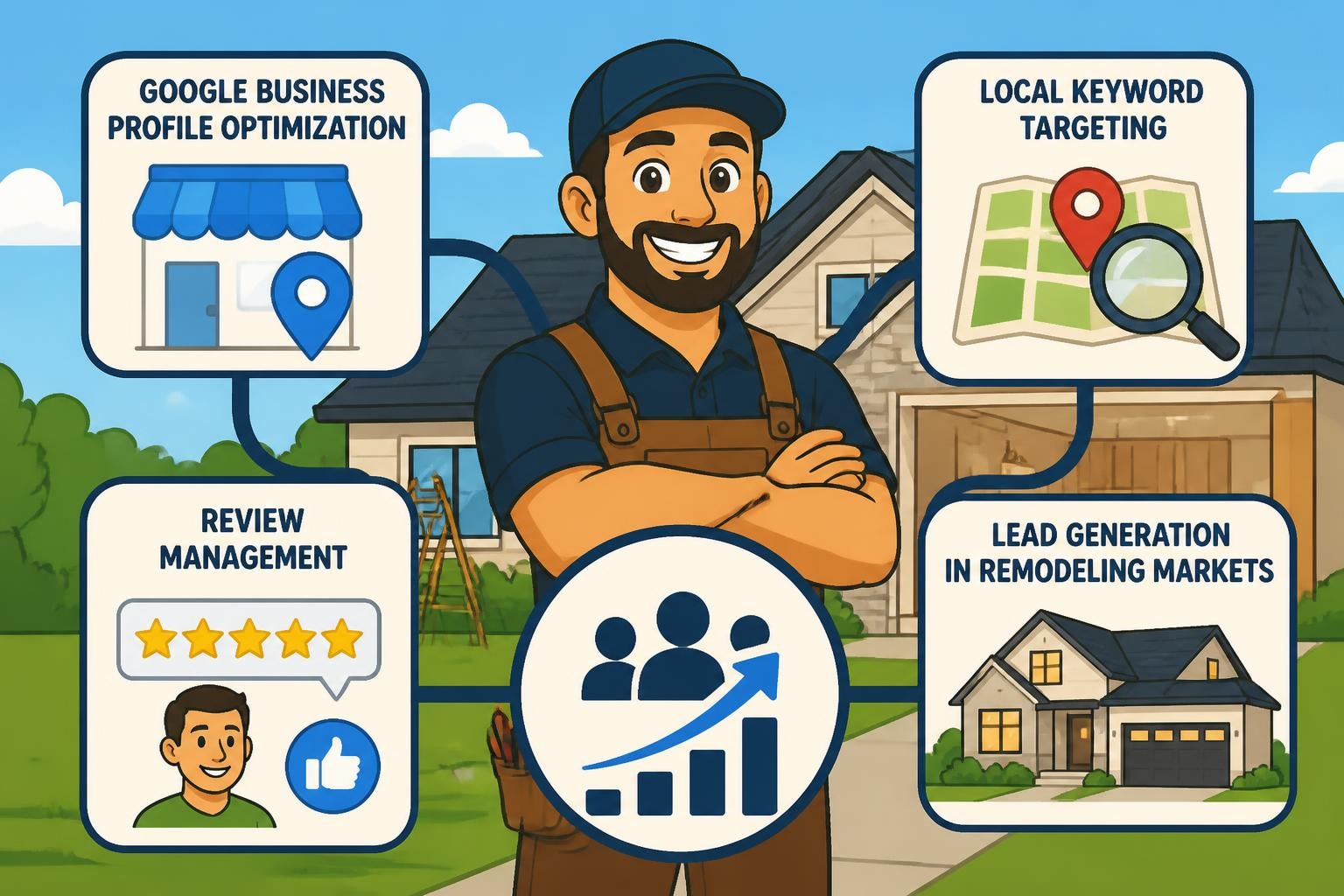
Remodeling contractors face unique challenges when trying to attract homeowners in their service area. While homeowners desperately search for reliable kitchen remodelers, bathroom renovation experts, and home addition specialists right in their neighborhoods, many quality contractors remain invisible online. The solution lies in mastering local SEO for remodeling contractors, a specialized approach that puts your business in front of ready-to-buy homeowners exactly when they're searching for your services. Whether you're a solo contractor or managing a team, implementing targeted local SEO strategies can transform your online presence from invisible to indispensable in your community.
Why Local SEO Matters More Than Ever for Remodeling Businesses
The remodeling industry has fundamentally changed in how homeowners find and hire contractors. Gone are the days when word-of-mouth and yard signs drove most business. Today, 78% of homeowners begin their contractor search online, and most never scroll past the first page of search results.
Local SEO for remodeling contractors addresses this shift by ensuring your business appears prominently when homeowners in your service area search for terms like "kitchen remodeler near me" or "bathroom renovation in [city name]." This visibility directly translates to phone calls, quote requests, and booked projects.
The Real Cost of Ignoring Local Search
Consider what happens when your business doesn't rank locally:
- Potential clients find your competitors first
- Your website traffic remains stagnant
- Lead generation costs stay high
- Project pipelines develop gaps
- Revenue growth plateaus
Conversely, contractors who invest in local SEO strategy see measurable results within months. These businesses capture more organic leads, reduce their advertising spend, and build sustainable growth engines that compound over time.

Google Business Profile: Your Local SEO Foundation
Your Google Business Profile (formerly Google My Business) serves as the cornerstone of local SEO for remodeling contractors. This free tool controls how your business appears in Google Maps and local search results, making it your most powerful visibility asset.
Optimizing your profile requires attention to these critical elements:
- Complete business name, address, and phone number (NAP)
- Accurate service area definitions
- Primary and secondary business categories
- Detailed business description with relevant keywords
- High-quality photos of completed projects
- Regular posts about recent work and special offers
Category Selection Strategy
Choosing the right categories dramatically impacts your visibility. Your primary category should precisely match your main service offering. For remodeling contractors, consider these options:
| Primary Category | Best For | Secondary Categories |
|---|---|---|
| Remodeler | Full-service remodeling | Kitchen remodeler, Bathroom remodeler |
| Kitchen remodeler | Kitchen specialists | Countertop installer, Cabinet maker |
| Bathroom remodeler | Bathroom specialists | Tile contractor, Plumber |
| Home builder | New construction + remodels | General contractor, Construction company |
Don't overlook secondary categories. These expand your visibility for specific services while maintaining focus on your primary offering. Many successful contractors use five to seven categories strategically to capture diverse search queries.
Building a Location-Optimized Website
Your website must work hand-in-hand with your Google Business Profile to maximize local visibility. This means creating content and structure specifically designed for local SEO marketing effectiveness.
Start by ensuring every page includes location-specific elements. Your homepage should clearly state your service area, your about page should mention your community involvement, and your contact page needs a local phone number and address.
Creating Service Area Pages That Convert
Service area pages represent one of the most effective tactics for local SEO for remodeling contractors. Each page targets a specific city or neighborhood within your service area, providing detailed information about your services in that location.
Effective service area pages include:
- Location name in the page title and H1 heading
- Description of services offered in that specific area
- Local landmarks and neighborhood references
- Testimonials from clients in that location
- Photos of completed projects in the area
- Embedded Google Map showing your service coverage
These pages shouldn't feel like duplicate content. Each should contain unique information about the specific community, local building requirements, popular home styles in the area, and relevant case studies.
Content Marketing for Local Relevance
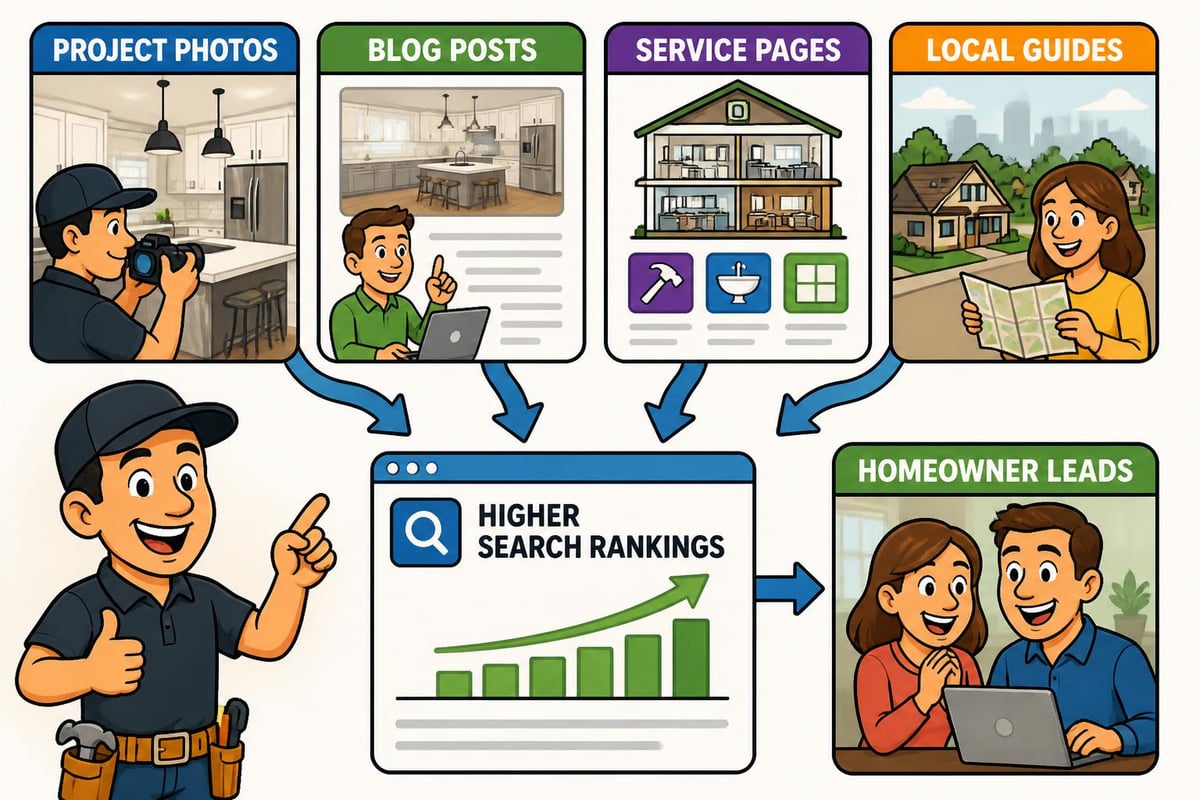
Creating valuable content establishes your expertise while targeting the search terms homeowners actually use. The key is balancing educational content with local relevance.
Blog posts about "Kitchen Remodeling Trends in Bucks County" or "Bathroom Renovation Costs in Philadelphia" naturally incorporate location keywords while providing genuine value. This approach mirrors successful strategies used across service-based business SEO.
Content Topics That Generate Local Traffic
- Before-and-after project showcases featuring local homes
- Seasonal remodeling guides tied to your climate and weather
- Local permit and code guides for homeowners planning projects
- Neighborhood home style profiles highlighting renovation opportunities
- Cost guides specific to your market addressing local pricing
Each piece should answer real questions your potential clients ask. When homeowners search for specific information, your detailed, locally-focused content positions you as the trusted expert in your community.
Review Generation and Reputation Management
Online reviews directly influence both your search rankings and conversion rates. Google considers review quantity, quality, and recency when determining local search positions, while homeowners read reviews before contacting contractors.
Successful review generation starts with systematic processes. After completing each project, send a polite review request via email or text. Make the process effortless by providing direct links to your Google Business Profile review page.
Your review strategy should include:
- Automated follow-up sequences after project completion
- Multiple touchpoints requesting feedback
- Easy-to-use review links sent via text message
- Responses to every review (positive and negative)
- Integration with your project management workflow
When you receive negative reviews, respond professionally and publicly. This demonstrates your commitment to customer satisfaction while providing context for future readers. Many homeowners actually prefer contractors who professionally handle complaints over those with exclusively perfect reviews.
Local Citation Building and NAP Consistency
Citations are online mentions of your business name, address, and phone number across various directories and websites. These citations validate your business location and legitimacy, improving your local search rankings.
Building citations requires both breadth and accuracy. You want your business listed across major directories while ensuring every listing contains identical information.
| Citation Type | Examples | Priority Level |
|---|---|---|
| Major directories | Yelp, Yellow Pages, BBB | High |
| Industry-specific | Houzz, Porch, Angi | High |
| Local directories | Chamber of Commerce, local business associations | Medium |
| General directories | Facebook, Apple Maps, Bing Places | Medium |
Start with the highest-priority citations and work down. More importantly, audit existing citations for inconsistencies. Even small variations in your business name or address can dilute your SEO effectiveness. Comprehensive local SEO tips often emphasize citation accuracy as a foundational element.
Technical SEO Essentials for Local Visibility
While content and citations matter tremendously, technical factors determine whether Google can properly crawl, index, and rank your website. Remodeling contractors often overlook these elements, creating easy opportunities to outrank competitors.
Mobile Optimization is Non-Negotiable
Over 60% of homeowners search for contractors on mobile devices. Your website must load quickly, display properly on small screens, and make it effortless to call or request quotes on smartphones.
Test your mobile experience regularly. Navigate your own site on your phone. Can you easily find your phone number? Do forms work smoothly? Do images load quickly? These factors affect both user experience and search rankings.
Schema Markup for Local Businesses
Schema markup is code that helps search engines understand your business information. For local SEO for remodeling contractors, implementing LocalBusiness schema tells Google exactly what you do, where you operate, and how to contact you.
Essential schema properties include:
- Business name and legal name
- Full address and service area radius
- Phone number and email
- Business hours
- Service types offered
- Price range
- Reviews and ratings
Many contractors also benefit from adding schema for specific services, reviews, and frequently asked questions. This structured data can trigger enhanced search results like rich snippets and knowledge panels.
Link Building with Local Focus
Backlinks from other websites signal authority and trustworthiness to search engines. For local SEO for remodeling contractors, links from local websites carry particular weight.
Effective local link building strategies include:
- Sponsoring local sports teams or community events
- Partnering with complementary local businesses
- Contributing to local news sites and blogs
- Joining local business associations and chambers
- Creating scholarship programs at local schools
- Hosting or participating in home shows and community events
Quality matters more than quantity. A single link from your local newspaper or a well-respected community organization provides more SEO value than dozens of links from irrelevant websites. This principle applies across various contractor SEO approaches.
Understanding your current search performance provides the foundation for improvement. If you're unsure where your local SEO stands right now, the Authority + AI Visibility Blueprint can provide a comprehensive audit of your presence in Google and emerging AI search platforms, giving you a clear roadmap for getting found by homeowners actively searching for remodeling services.

Tracking Your Local SEO Performance
Measuring results ensures your efforts generate actual business growth. Focus on metrics that directly correlate with revenue rather than vanity metrics that look good but don't translate to projects.
Key Performance Indicators Worth Monitoring
| Metric | Why It Matters | Target Trend |
|---|---|---|
| Google Business Profile views | Indicates local search visibility | Increasing monthly |
| Direction requests | Shows intent to visit or work with you | Increasing monthly |
| Website clicks from GBP | Measures profile effectiveness | Higher click-through rate |
| Phone calls from search | Direct lead generation | Increasing volume |
| Organic local keyword rankings | Visibility for target searches | Ranking positions improving |
| Conversion rate from organic traffic | Lead quality indicator | Steady or increasing |
Google Analytics and Google Search Console provide much of this data for free. Set up monthly reporting to track trends over time rather than obsessing over daily fluctuations. Understanding how local SEO works helps you interpret these metrics effectively.
Competitive Analysis for Market Advantage
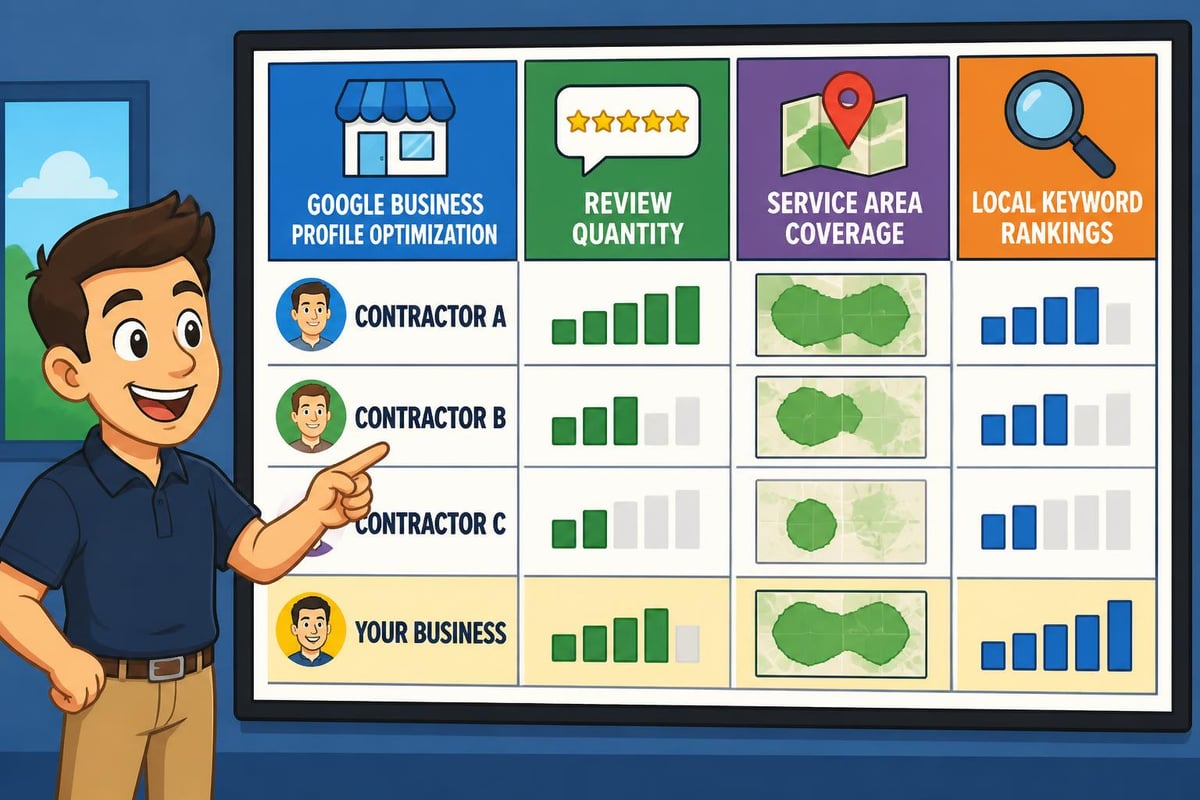
Your competitors' SEO strategies reveal opportunities and gaps in your own approach. Regular competitive analysis keeps you informed about market dynamics and helps you identify untapped keywords or underserved service areas.
Start by identifying your top three to five local competitors-the businesses that consistently outrank you for important keywords. Analyze their Google Business Profiles, website content, review volumes, and backlink profiles.
Questions to answer through competitive analysis:
- What keywords do they rank for that you don't?
- Which service areas do they target more aggressively?
- What types of content generate the most engagement?
- How many reviews do they have compared to you?
- What local organizations or websites link to them?
This intelligence directly informs your strategy. If a competitor dominates a particular neighborhood, consider whether you should compete directly or focus on underserved areas where you can establish dominance more easily.
Voice Search Optimization for Contractor Queries
Voice search continues growing as homeowners use Siri, Alexa, and Google Assistant to find local services. These searches differ from typed queries, requiring specific optimization approaches.
Voice searches tend to be longer and more conversational. Instead of typing "kitchen remodeler Philadelphia," homeowners ask "Who's the best kitchen remodeling contractor near me?" Your content should naturally address these question-based queries.
Structuring Content for Voice Queries
Create FAQ sections answering common questions homeowners ask about remodeling projects. Use natural language matching how people actually speak. Write conversational answers that directly address the question in the first sentence.
Questions to address include:
- "How much does kitchen remodeling cost in [city]?"
- "How long does bathroom renovation take?"
- "Do I need permits for home additions in [city]?"
- "What's the best time of year to remodel?"
- "How do I choose a reliable remodeling contractor?"
This approach serves double duty. Voice search devices often pull answers from these FAQ sections, while homeowners browsing your site find immediate value in addressing their concerns.
Seasonal Local SEO Strategies
Remodeling demand fluctuates throughout the year, and your local SEO strategy should adapt accordingly. Understanding seasonal patterns helps you capture demand during peak periods while maintaining visibility during slower months.
Spring and early summer typically see increased home improvement searches as homeowners plan warm-weather projects. Fall brings another surge as people complete projects before holidays. Winter might slow down for exterior work but remains strong for interior remodeling.
Seasonal content opportunities:
- Spring: Deck and patio remodeling, exterior painting, home addition planning
- Summer: Kitchen renovations before school starts, basement finishing projects
- Fall: Bathroom remodeling for holiday guests, energy-efficiency upgrades
- Winter: Interior remodeling projects, planning for spring exterior work
Publishing timely content three to four weeks before peak demand periods positions you to capture search traffic as it builds. This forward-thinking approach, similar to strategies used in HVAC contractor SEO, ensures visibility when homeowners start researching projects.
Integration with Paid Local Advertising
While organic local SEO for remodeling contractors provides sustainable long-term results, combining it with paid local advertising creates comprehensive market coverage. Google Local Services Ads and Google Ads can fill gaps while your organic rankings develop.
The most effective approach uses paid advertising to test keywords and markets before investing heavily in organic optimization. If certain keywords convert well in paid campaigns, prioritize them in your organic strategy.
Additionally, occupying both paid and organic positions for high-value searches significantly increases your total click-through rate. Homeowners see your business multiple times in search results, building familiarity and trust before they even visit your website.
Building Authority Through Community Involvement
True local authority extends beyond your website into your actual community presence. Google increasingly values signals that demonstrate genuine community connection and expertise.
Participate in local events, sponsor youth sports teams, contribute to community improvement projects, and engage with local organizations. These activities generate mentions, links, and social signals that reinforce your local relevance.
Document this involvement through your website blog, social media, and Google Business Profile posts. When you sponsor a Little League team, publish photos and write about your commitment to the community. When you donate materials to a community center renovation, share the story.
These genuine community connections differentiate you from competitors who exist purely online. They create authentic content opportunities, generate natural backlinks from local organizations, and build the real-world reputation that drives referrals alongside search visibility.
Avoiding Common Local SEO Mistakes
Even well-intentioned contractors make mistakes that undermine their local SEO efforts. Recognizing these pitfalls helps you avoid wasting time and resources on ineffective tactics.
Common mistakes to avoid:
- Using a PO Box instead of a physical address
- Keyword stuffing in Google Business Profile descriptions
- Creating duplicate listings for different service areas
- Ignoring negative reviews or responding defensively
- Neglecting to update business hours and information
- Purchasing fake reviews or review packages
- Building links from irrelevant or spammy websites
Many of these mistakes stem from trying to game the system rather than providing genuine value. Effective local SEO strategies prioritize sustainable, white-hat tactics that build lasting authority rather than short-term ranking manipulations.
The Evolution of Local Search in 2026
Staying current with local SEO trends ensures your strategies remain effective as search algorithms evolve. Several significant shifts are reshaping local search in 2026.
AI-powered search engines now understand user intent more accurately, meaning keyword optimization alone isn't enough. Your content must genuinely address the underlying questions and needs behind search queries.
Google's emphasis on expertise, experience, authoritativeness, and trustworthiness (EEAT) particularly impacts contractor searches. Homeowners entrust contractors with significant investments and their homes' safety, making trust signals crucial for rankings.
Visual search continues expanding, with homeowners increasingly using Google Lens to find contractors based on styles they photograph. Optimizing your image content with descriptive filenames, alt text, and captions helps capture this growing search behavior.
Mastering local SEO for remodeling contractors isn't a one-time project but an ongoing commitment to building genuine local authority and visibility. The contractors who win in local search combine technical optimization with authentic community engagement and valuable content that serves homeowners throughout their remodeling journey. If you're ready to transform your online visibility and build a sustainable pipeline of local leads, Shawn the SEO Geek brings over two decades of expertise helping home service businesses dominate their local markets through customized, results-driven SEO strategies.