
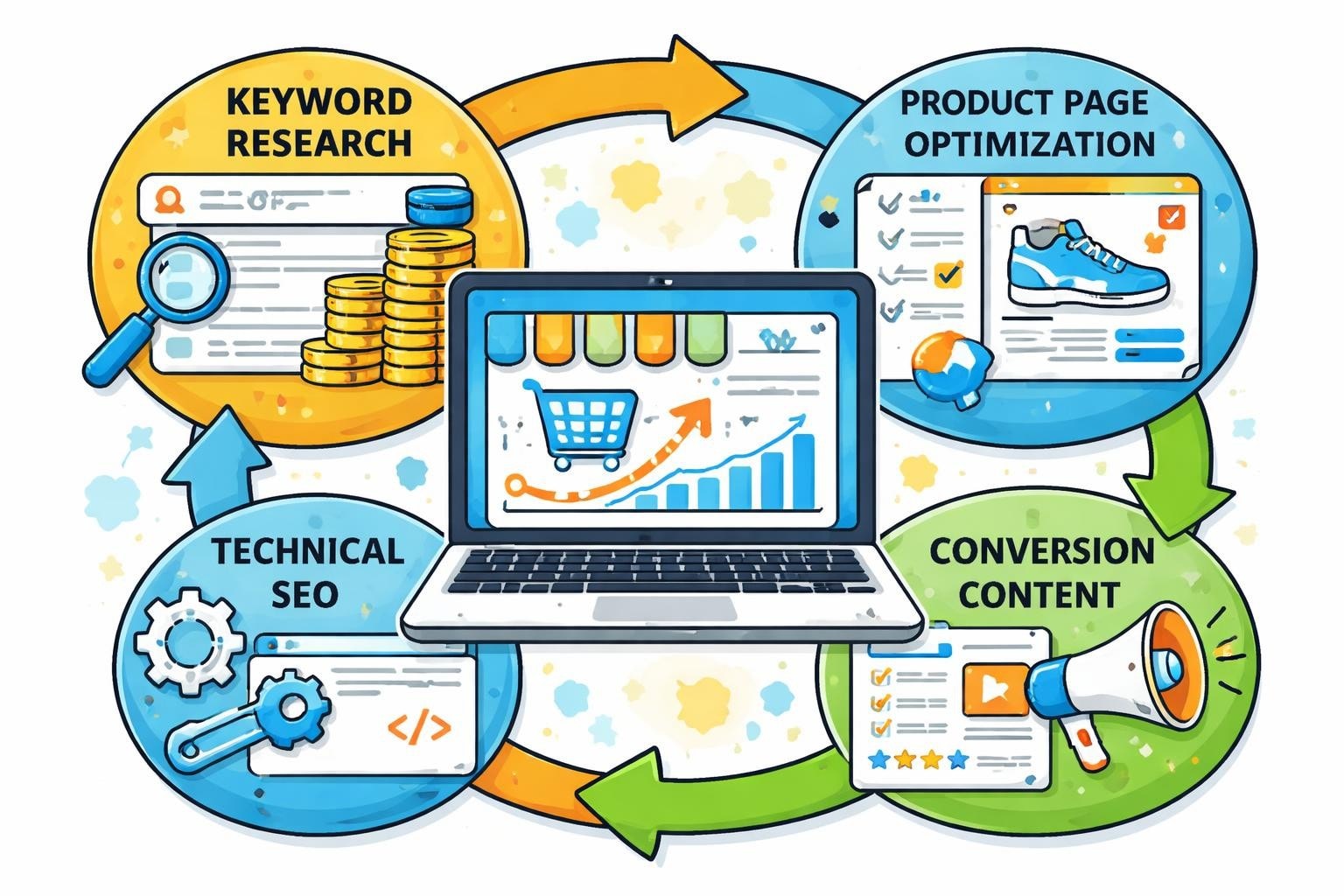
Running an ecommerce website means competing in one of the most challenging digital landscapes. You're not just up against local competitors-you're facing giants like Amazon, eBay, and thousands of specialty retailers. That's why having a solid SEO strategy for ecommerce website success isn't optional anymore. It's the difference between showing up on page one of Google or getting lost in the digital void. We've worked with hundreds of online retailers over the years, and we've seen firsthand how the right approach transforms struggling stores into traffic magnets that convert browsers into buyers.
Understanding Ecommerce SEO Fundamentals
Ecommerce SEO differs significantly from traditional website optimization. While a service business might have 20-30 pages to optimize, your online store could have hundreds or thousands of product pages, category pages, and filtering options. Each page represents an opportunity to rank and drive qualified traffic.
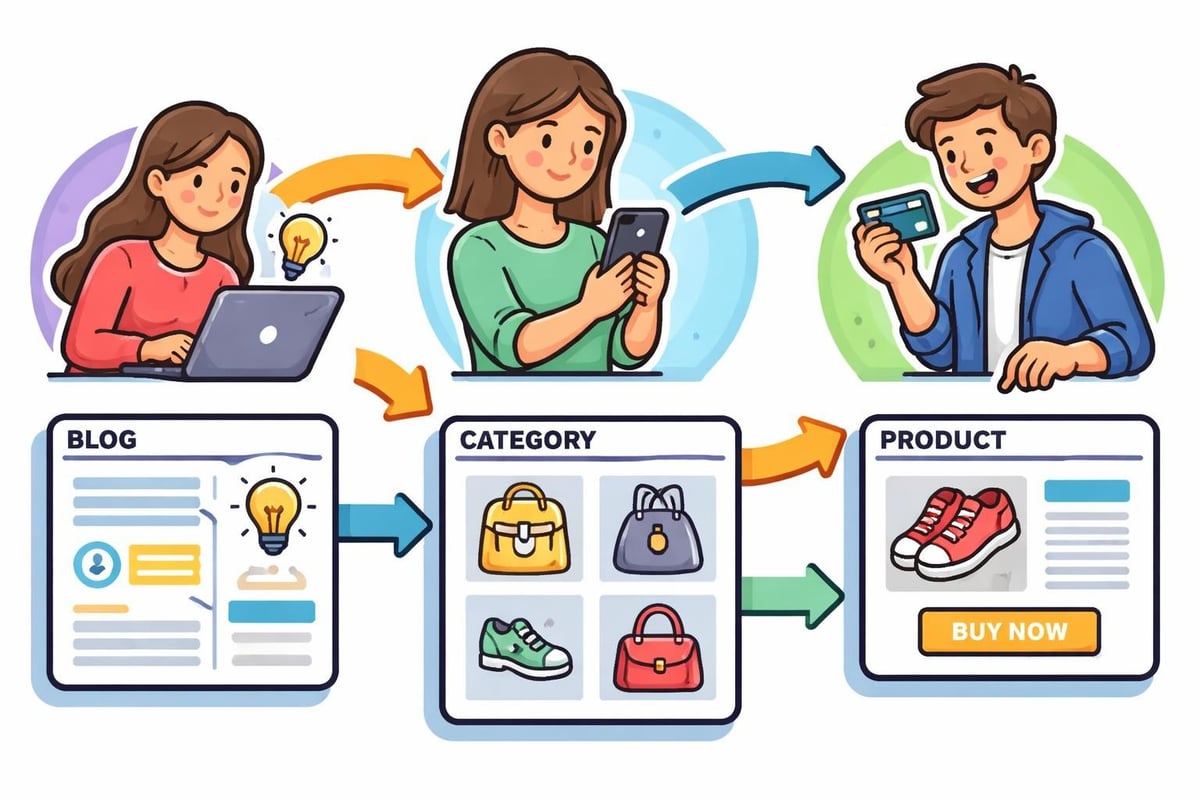
The foundation of any successful SEO strategy for ecommerce website growth starts with understanding your customer's search journey. Most shoppers don't immediately search for specific product names-they start with problems, needs, or general categories. Someone looking for running shoes might search "best cushioned running shoes for flat feet" before they ever type in a brand name.
Search Intent Matters More Than Ever
Google's algorithms have become incredibly sophisticated at understanding what searchers actually want. Your product pages need to match that intent perfectly.
Commercial intent keywords include phrases like:
- "Buy [product name]"
- "[Product] for sale"
- "Best [product] deals"
- "[Product] coupon code"
Informational intent keywords might be:
- "How to choose [product]"
- "[Product] comparison guide"
- "What is the best [product]"
When you align your content with search intent, you'll see higher rankings and better conversion rates. We've found that stores mixing both types of content through blogs and buying guides see 40-60% more organic traffic than those focusing solely on product pages.
Product Page Optimization Strategies
Your product pages are the heart of your ecommerce SEO strategy. These pages need to satisfy both search engines and potential customers, which means balancing technical optimization with persuasive content.
Crafting High-Converting Product Titles
Product titles serve double duty-they're your H1 tag and often become your page title in search results. Structure them strategically to include your target keyword while remaining readable.
Effective format: Brand + Product Type + Key Feature + Model/Variant
Example: "Nike Air Zoom Pegasus 40 Women's Running Shoes – Black/White"
This approach naturally incorporates keywords shoppers use while providing clear information about what you're selling. Avoid keyword stuffing or creating titles that read like spam. Google's gotten smart about detecting manipulation.
Writing Product Descriptions That Rank and Convert
Here's where many online stores fall short. They either copy manufacturer descriptions (creating duplicate content issues) or write thin, uninspiring content that doesn't help searchers or search engines.
Your descriptions should include:
- Primary keyword naturally placed in the first 100 words
- Feature bullets highlighting specifications and benefits
- Usage scenarios showing how customers use the product
- Related keywords woven throughout naturally
- Minimum 300-500 words for competitive products
| Product Description Element | SEO Benefit | Conversion Benefit |
|---|---|---|
| Unique content | Avoids duplicate content penalties | Builds brand trust |
| Keyword-rich paragraphs | Improves topical relevance | Answers customer questions |
| Technical specifications | Captures long-tail searches | Reduces returns |
| Customer use cases | Ranks for problem-solving queries | Increases purchase confidence |
The stores we work with that invest in unique, comprehensive product descriptions consistently outrank competitors using generic manufacturer content. It's more work upfront, but the long-term payoff is substantial.
Technical SEO for Ecommerce Platforms
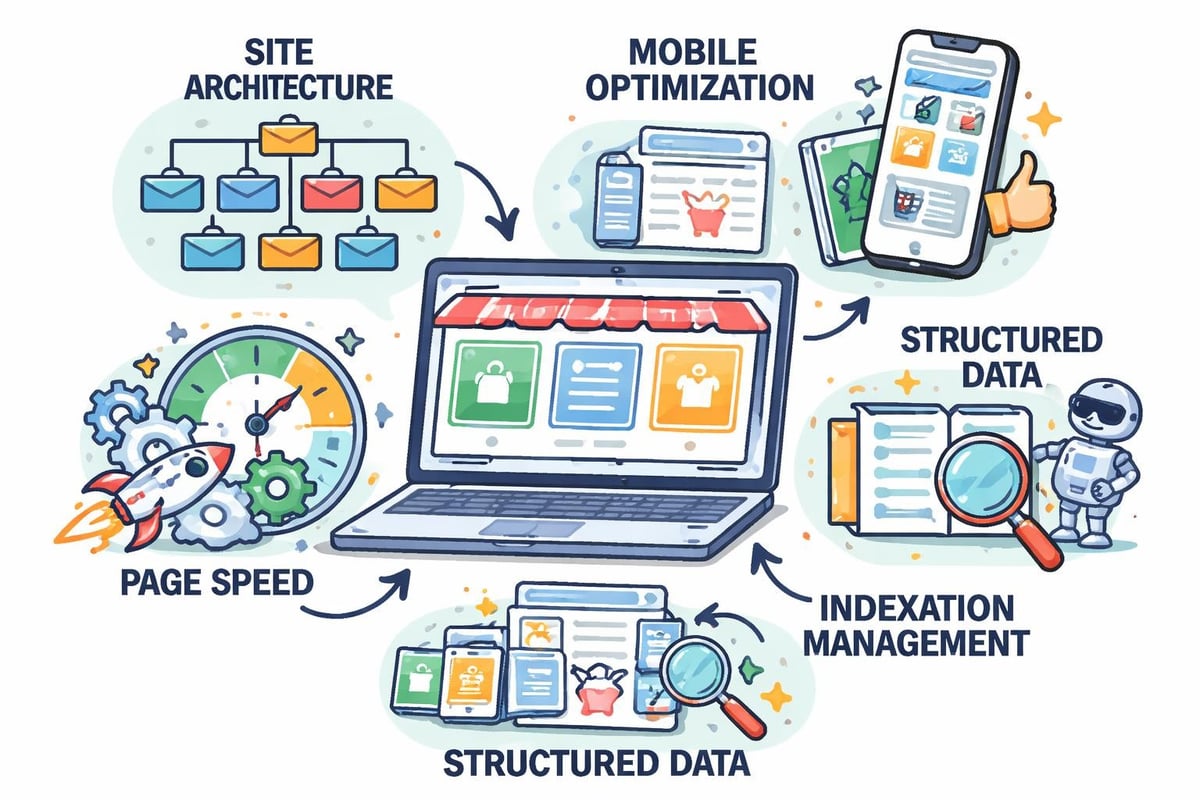
Technical optimization makes or breaks your SEO strategy for ecommerce website performance. Even perfect content won't rank if search engines struggle to crawl, index, and understand your site structure.
Site Architecture and URL Structure
Your site architecture should create a logical hierarchy that users and search engines can easily navigate. Most successful ecommerce sites follow this structure:
- Homepage
- Category pages
- Subcategory pages (if needed)
- Product pages
Keep your URLs clean, descriptive, and keyword-rich. Avoid dynamically generated URLs with parameters whenever possible. According to essential SEO tips from Sachs Marketing Group, optimizing URL structures significantly improves both search rankings and user engagement.
Good URL: yourstore.com/mens-running-shoes/trail-running-shoes/product-name
Bad URL: yourstore.com/product?id=12345&cat=78&ref=home
Managing Duplicate Content
Ecommerce sites naturally create duplicate content through product variations, filters, and sorting options. If you sell a shirt in five colors and three sizes, you could have 15 nearly identical pages competing against each other.
Solutions include:
- Canonical tags pointing variations to a primary version
- Parameter handling in Google Search Console
- Noindex tags for filter and sort pages
- Product consolidation with variant selectors on a single page
Working with an experienced ecommerce SEO consultant can help you navigate these technical challenges without accidentally de-indexing important pages.
Page Speed and Core Web Vitals
Google's Core Web Vitals are now ranking factors, and ecommerce sites often struggle with them due to large images, complex product galleries, and heavy scripts. Your customers expect pages to load in under three seconds-anything slower dramatically increases bounce rates.
Optimization tactics:
- Compress and optimize product images (WebP format works great)
- Implement lazy loading for images below the fold
- Minimize JavaScript and CSS files
- Use a content delivery network (CDN)
- Enable browser caching
- Consider Progressive Web App (PWA) technology
We've seen stores increase conversion rates by 20-30% simply by improving load times from four seconds to under two seconds. Speed isn't just an SEO factor-it directly impacts your bottom line.
Category and Collection Page Strategies
Many ecommerce businesses focus exclusively on product pages and neglect category pages. That's a huge mistake. Category pages often target higher-volume keywords and serve as crucial entry points for shoppers still in the research phase.
Optimizing Category Page Content
Don't leave your category pages as simple product listings. Add 300-500 words of unique, helpful content that explains what the category includes, who it's for, and why someone should shop this collection.
Place this content strategically-either above the product grid with a "read more" expansion or below the initial products. This content should target your primary category keyword while naturally incorporating related terms.
Internal Linking Architecture
Category pages should link to relevant subcategories and featured products. Product pages should link back to their parent category and to related products. This internal linking structure helps search engines understand your site hierarchy and passes authority throughout your site.
According to strategies from HawkSEM, incorporating specific keywords into page titles and descriptions while emphasizing user experience creates stronger category page performance.
Internal linking best practices:
- Link from high-authority pages to newer or underperforming pages
- Use descriptive anchor text (not "click here")
- Create related product sections on each product page
- Build topical clusters linking related categories together
- Include breadcrumb navigation
Content Marketing for Ecommerce SEO
Product and category pages alone won't capture all the search traffic in your niche. You need content that answers questions, solves problems, and builds trust before someone's ready to buy.
Building a Strategic Blog
Your blog should target informational keywords that attract potential customers in the awareness and consideration stages. Someone searching "how to choose running shoes" isn't ready to buy yet, but they will be soon. If you provide helpful content now, you'll be their first stop when they're ready to purchase.
High-performing ecommerce content types:
- Buying guides and comparison articles
- How-to tutorials featuring your products
- Industry trends and news
- Customer success stories and case studies
- Problem-solving content addressing common pain points
We recommend publishing 2-4 high-quality blog posts monthly rather than churning out daily low-value content. Quality beats quantity every time. These articles should be 1,500-2,500 words, thoroughly researched, and genuinely helpful.
User-Generated Content
Customer reviews, Q&A sections, and user photos serve double duty-they build trust and create fresh, unique content that search engines love. Groove Commerce highlights that adding customer reviews and structured markup can significantly enhance SEO performance.
Products with 50+ reviews typically rank higher than identical products with few or no reviews. Encourage reviews through post-purchase emails, loyalty programs, and making the review process simple.
Schema Markup and Rich Results
Structured data helps search engines understand your content and can earn you rich results in search-those enhanced listings with star ratings, prices, and availability information.
Essential Schema Types for Ecommerce
Implementing schema markup is crucial for any comprehensive SEO strategy for ecommerce website visibility. As noted by Web Retailer’s SEO tips, schema markup helps search engines understand website content and improve search result visibility.
Priority schema types:
| Schema Type | Purpose | Benefit |
|---|---|---|
| Product | Details about individual products | Shows price, availability, ratings in search |
| Review | Customer ratings and reviews | Displays star ratings in search results |
| BreadcrumbList | Navigation path | Shows site hierarchy in search |
| Organization | Business information | Builds brand knowledge graph |
| FAQ | Question and answer content | Can trigger FAQ rich results |
You can implement schema through JSON-LD code (Google's preferred method), your ecommerce platform's built-in tools, or plugins. Test your markup using Google's Rich Results Test to ensure it's correctly implemented.
Link Building for Ecommerce Sites
Building high-quality backlinks remains one of the most challenging aspects of ecommerce SEO. Unlike service businesses that can guest post or create local partnerships easily, product-focused sites need creative approaches.
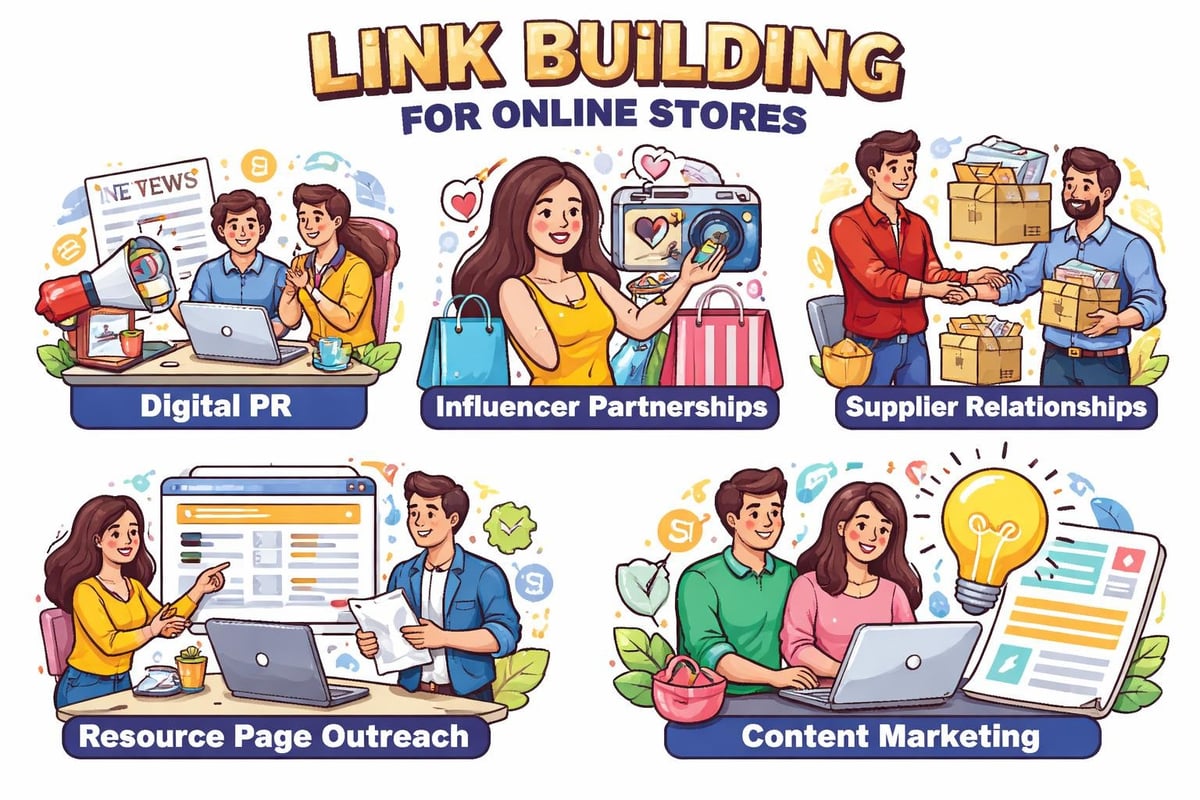
Effective Link Building Tactics
Digital PR and newsworthy content: Create data studies, surveys, or trend reports that journalists want to cite. A single viral study can generate hundreds of authoritative links.
Supplier and manufacturer partnerships: Many suppliers will link to authorized retailers. Ask to be included in their "where to buy" pages.
Influencer collaborations: Product reviews from industry influencers naturally generate links and social signals.
Resource page outreach: Find "best [product category]" resource pages and pitch your store for inclusion.
The approach that consistently works best? Creating genuinely valuable content that others want to reference. According to SEO.com’s ecommerce guide, focusing on enhancing E-E-A-T (Experience, Expertise, Authoritativeness, Trustworthiness) helps build the reputation that attracts natural links.
Mobile Optimization and Voice Search
Over 60% of ecommerce traffic now comes from mobile devices, and that percentage keeps climbing. Your SEO strategy for ecommerce website success must prioritize mobile experience.
Mobile-First Design Principles
Google uses mobile-first indexing, meaning it primarily uses your mobile site version for ranking. If your mobile experience is poor, your rankings suffer regardless of how good your desktop site looks.
Mobile optimization checklist:
- Responsive design that adapts to all screen sizes
- Touch-friendly buttons and navigation (minimum 48×48 pixels)
- Simplified checkout process with minimal form fields
- Mobile-optimized images that load quickly
- Easily readable text without zooming (minimum 16px font)
- Pop-ups that don't cover content or frustrate users
Preparing for Voice Search
Voice search queries tend to be longer and more conversational than typed searches. Instead of "blue running shoes," someone might ask their device "what are the best running shoes for marathon training?"
Optimize for voice by targeting question-based keywords, creating FAQ content, and ensuring your product information directly answers common questions. Local businesses should also claim and optimize their Google Business Profile for "near me" voice searches.
Measuring and Refining Your Strategy
You can't improve what you don't measure. Track the right metrics to understand what's working and where you need to adjust your approach.
Key Performance Indicators
Beyond basic traffic numbers, monitor these specific ecommerce SEO metrics:
- Organic revenue: Traffic means nothing without sales
- Conversion rate by landing page: Which pages turn visitors into customers?
- Keyword rankings: Track your target terms over time
- Page authority scores: Monitor which pages are building authority
- Bounce rate and time on page: Indicates content quality and relevance
- Product page indexation: Ensure all products are indexed
As Experro’s SEO strategy guide emphasizes, integrating proper tracking and embracing user experience design principles helps refine your approach based on actual performance data.
Regular SEO audits help identify technical issues, content gaps, and new opportunities before they significantly impact your rankings.
Seasonal and Promotional SEO
Ecommerce businesses face unique seasonal fluctuations. Your SEO strategy for ecommerce website traffic should account for peak seasons, holidays, and promotional periods.
Planning Seasonal Content
Start your seasonal SEO efforts 2-3 months before peak periods. Create holiday gift guides, seasonal buying guides, and themed collections that target seasonal keywords.
Example timeline for holiday shopping:
- August-September: Publish initial holiday content and guides
- October: Optimize product pages for gift-related keywords
- November: Launch promotional landing pages
- December: Focus on last-minute and express shipping keywords
Don't abandon seasonal content after the season ends. Keep it published and update it annually. Google favors established content that's been refined over time.
Handling Discontinued Products
Products go out of stock or get discontinued constantly in ecommerce. How you handle these pages significantly impacts SEO. According to Go Elastic’s ecommerce SEO tips, conducting thorough keyword research and addressing technical SEO issues prevents traffic loss from discontinued inventory.
Options for discontinued products:
- 301 redirect to the replacement product or similar alternative
- Keep the page live with "out of stock" messaging and similar product recommendations
- Update the page to recommend current alternatives with explanatory content
- Temporary 301 to category page if no direct replacement exists
Never simply delete product pages with established rankings and backlinks. You'll lose valuable SEO equity and frustrate customers who bookmarked those pages.
Competitive Analysis and Market Positioning
Understanding your competitive landscape helps you identify opportunities your competitors are missing and avoid strategies that won't work in your niche.
Analyzing Competitor Strategies
Study the top 5-10 competitors in your space. Look at their site structure, content approach, backlink profiles, and keyword targeting. Tools like Ahrefs, SEMrush, or Moz can reveal which keywords they rank for and which pages drive their traffic.
Key competitive insights:
- Which keywords do they rank for that you don't?
- What content types perform best in your niche?
- Where are their backlinks coming from?
- What's their site structure and internal linking approach?
- How do they handle product variations and filters?
This competitive intelligence shapes your strategy, helping you find gaps in the market where you can establish authority. Maybe competitors focus entirely on product pages while neglecting informational content. That's your opportunity.
Working with a B2B SEO firm or specialized agency can accelerate this competitive analysis process and help you implement insights faster than trying to do everything in-house.
International and Multi-Language SEO
If you sell internationally or to multilingual audiences, your SEO complexity multiplies. Each language and country needs its own optimization approach.
Implementing Hreflang Tags
Hreflang tags tell search engines which language version of a page to show users based on their location and language settings. Improper implementation causes major ranking issues and traffic loss.
Hreflang best practices:
- Include all language variations of each page
- Use consistent URL structures across languages
- Ensure return tags (if page A links to page B, page B should link back to page A)
- Validate implementation using Google Search Console
- Consider subdirectories (/en/, /es/) or country-specific domains
Localization Beyond Translation
True localization goes beyond translating text. Adapt your content for local search behavior, cultural preferences, pricing conventions, and shopping habits. Someone in Germany searches differently than someone in the United States, even when both speak English.
Building Long-Term SEO Success
Ecommerce SEO isn't a one-time project-it's an ongoing process of optimization, testing, and refinement. The strategies that work today might need adjustment as search algorithms evolve, competitors improve, and consumer behavior changes.
The most successful online retailers we work with treat SEO as a core business function, not a marketing afterthought. They allocate resources for content creation, technical maintenance, and continuous improvement. They understand that ranking #1 for high-value keywords can generate more revenue than any paid advertising campaign.
Stay current with algorithm updates, test new approaches, and always prioritize user experience alongside search optimization. When you make decisions that genuinely help your customers, you're usually making decisions that help your SEO too.
For specialized support, many businesses benefit from partnering with agencies offering SEO services for ecommerce websites that understand the unique challenges online retailers face. Whether you're launching a new store or scaling an established brand, the right strategic approach makes all the difference between struggling for visibility and dominating your niche.
Building a comprehensive SEO strategy for ecommerce website growth requires balancing technical optimization, compelling content, strategic link building, and constant refinement based on performance data. The online retail landscape grows more competitive every year, but stores that invest in sustainable SEO practices consistently outperform those relying solely on paid traffic. At Shawn the SEO Geek, we've spent over two decades helping businesses across industries develop customized SEO strategies that drive measurable results, and we'd love to help your online store achieve its growth goals.